
OFF in one corner of Madrid’s iconic Puerta del Sol, the bronze-and-stone statue of a brown bear rises above the crowds of passers-by that fill the square.
Standing on its hind legs, the animal rests its front paws on the canopy of a strawberry tree, its muzzle curiously sniffing at the plump fruits concealed among the leaves.
A symbol of the Spanish capital since it was erected in 1967, the four-metre sculpture harks back to a time when brown bears roamed freely across the plains of central Spain.
The hulking mammals, thankfully, are no longer a common sight in what is now a sprawling metropolis of three and a half million people.
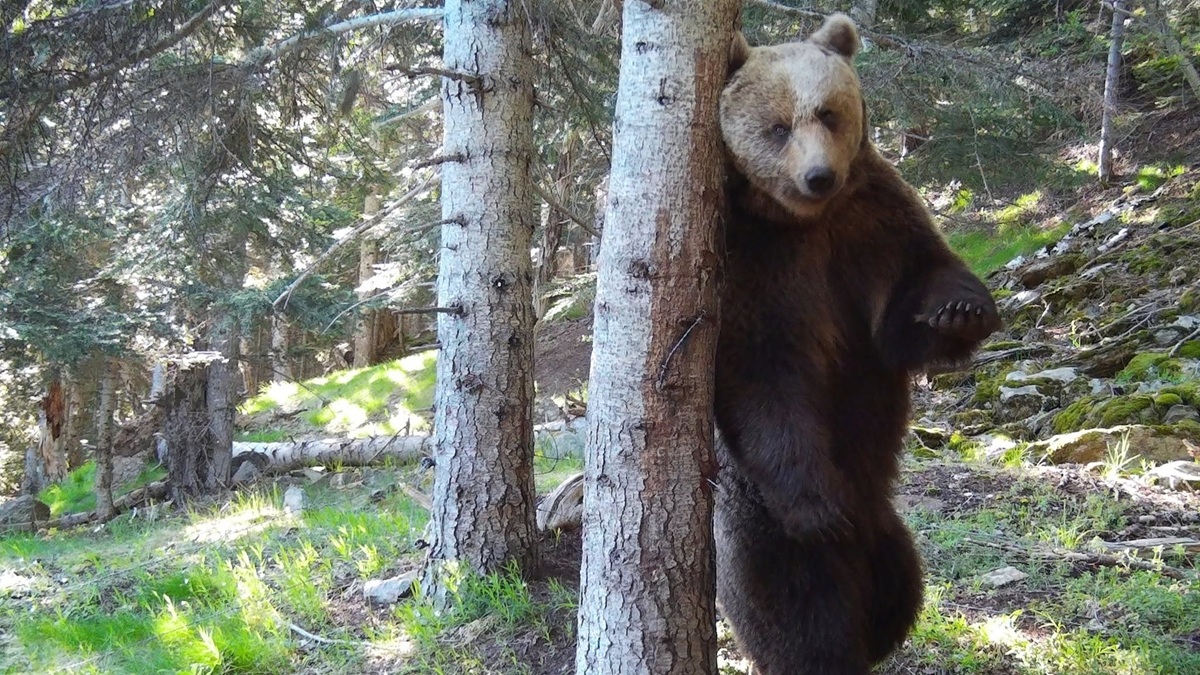
But a pristine 74,000-acre natural park in Asturias, along the Cantabrian coast in northern Spain, is still home to one of the largest populations of brown bears in western Europe – and is attracting animal enthusiasts in ever greater numbers.
According to conservationist group Fundacion Oso Pardo, the Somiedo Natural Park held an estimated population of around 300 Cantabrian brown bears in 2024.
This makes Asturias Spain’s largest stronghold for this endangered animal, though smaller populations can also be found elsewhere along the northern coast and in the Pyrenees, by the border with France.
More than a dozen businesses offering bear-watching experiences have sprung up across Asturias in recent years, according to local tourism boards – with about a third of them operating in Somiedo alone.
And nature enthusiasts eager to watch the bears in their natural habitat have been increasingly flocking to the park, with Somiedo logging more than 30,000 visits in 2024 alone.
One of the best places to spot them is around the villages of Gua, La Peral and Pola de Somiedo, where wide mountain views offer clear sightlines across the surrounding slopes.
At Gua, visitors can watch from a purpose-built viewpoint, while La Peral offers another elevated platform overlooking the hillsides where bears often forage and roam.
READ MORE: These are the three ‘most beautiful’ cinemas in Spain, according to leading travel magazine
Though Cantabrian bears are used to coexisting with humans and not as aggressive as grizzlies, the safest way to watch them is from a distance.
Telescopes or binoculars allow visitors to observe the animals without disturbing them or blocking their natural movements.
Specialist guides can also take visitors to authorised observation points, often spending several hours patiently scanning the mountains for movement among the trees and meadows.
The bears are wild animals, however, meaning there is never any guarantee of a sighting – and approaching one on foot is strictly the wrong way to find it.
Spain’s Environment Ministry recommends using established observation points, staying on authorised paths and keeping enough distance that the animal remains unaware of the observer.
The advice is designed to protect both bears and people, with experts stressing that the animals should never be followed, approached or disturbed while feeding, resting or raising cubs.
Somiedo is not the only corner of Spain where visitors can glimpse a bear, with the species also roaming the forests and mountains of the wider Cantabrian range, also along the northern coast.
Nearby Fuentes del Narcea in Asturias is another major bear-watching destination, while Picos de Europa stretches across Asturias, Cantabria and Leon and is home to brown bears.
READ MORE: This is the best city in Spain for a quick getaway this October, according to The Times
Further east, visitors can explore bear country in the Pyrenees, particularly around Catalunya’s Val d’Aran and Pallars Sobira, where the population is concentrated.
The animals also inhabit protected areas including Alt Pirineu and Ordesa y Monte Perdido, although sightings there are considerably harder because the Pyrenean population is smaller and more dispersed.
When bear-watching, patience is essential. The animals often appear only briefly before disappearing behind vegetation, across a ridge or into the dense woodland that covers much of their territory.
The reward can be spectacular, however, with visitors sometimes watching mothers shepherd their cubs, males crossing open slopes or solitary animals stopping to forage in mountain meadows.
Brown bears are powerful omnivores, eating everything from plants, berries and other wild fruits to insects and animal matter when it is available.
They spend the warmer months building up fat reserves before winter, when they retreat into sheltered dens and enter a prolonged period of reduced activity.
READ MORE: King of wines: Portugal’s little-known Dão region is a ‘classic with a new soul’
Despite their enormous size, Cantabrian bears are surprisingly elusive, with their excellent sense of smell and preference for dense, mountainous terrain helping them avoid people.
Females are particularly protective of their cubs, while adult males generally roam alone, making encounters between people and bears both unusual and potentially dangerous.
Yet the biggest threat to Spain’s bears has historically come not from their size or behaviour, but from people hunting and persecuting them.
By the late 1980s, fewer than 60 Cantabrian brown bears remained, pushing the species towards the brink of extinction across the mountain range.
The creation of protected areas, hunting bans, habitat protection and decades of conservation work have since helped the population recover, particularly in western Cantabria.
But the recovery remains fragile, with the western and eastern Cantabrian populations still largely isolated from one another, limiting genetic exchange between the two groups.
Conservationists are therefore working to create and protect wildlife corridors, allowing bears to move between fragmented habitats and improving the chances of keeping the populations genetically healthy.
In Somiedo and neighbouring councils, projects are also helping communities live alongside the animals by installing electric fences and bear-proof rubbish containers.
The aim is to prevent bears from becoming accustomed to human food, reducing the likelihood of conflict while allowing the animals to remain genuinely wild.
Climate change is adding another challenge, with warmer conditions affecting the wild fruits and other foods bears rely on before winter.
Scientists have also found that changing conditions can shorten hibernation, potentially increasing the amount of time bears spend moving through landscapes occupied by people.
That delicate balance is increasingly important in Somiedo, where conservation and tourism have become intertwined with the survival of one of Spain’s most remarkable wild animals.
Click here to read more Animals News from The Olive Press.