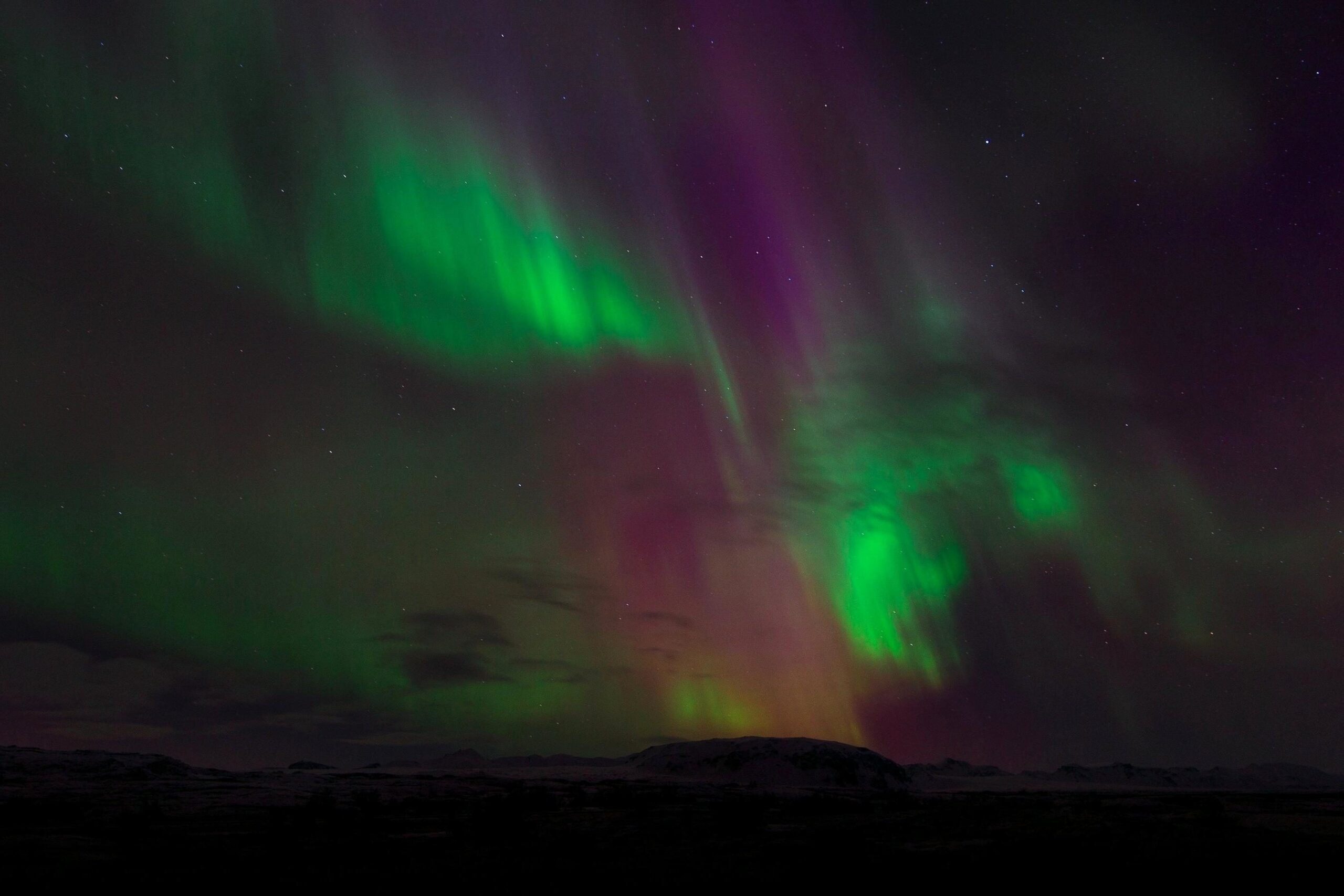
ONE night in May last year, the sky over Zaragoza shimmered with ribbons of green and violet light — a spectacle that left onlookers spellbound.
It was an exceedingly rare sight for Spain: the northern lights, or aurora borealis, are typically reserved for regions close to the Arctic Circle — Norway, Finland, or Iceland.
Yet, under exceptional circumstances, this natural phenomenon can drift much farther south.
And this week, for the second year in a row, a lucky few in northern Spain may get to witness it once more.
The peak window to catch the northern lights will fall between October 22 and 29.
For city dwellers, however, the show may prove elusive. Light pollution, smog, and urban haze all conspire to dim the display.
The best viewing conditions will be found in rural areas with dark, unpolluted skies — and the farther north, the better.
Regions such as Asturias, Galicia, Cantabria, Navarra, and the Basque Country hold the most promise, though mountainous areas with clear skies and crisp air — like Catalunya or the Pyrenees — may also offer fine vantage points.
Skywatchers farther inland are likely to miss the main event, though some may glimpse a faint red glow rippling among the stars from higher elevations.
The aurora can appear at any time from dusk until dawn, but the prime viewing hours fall between 10pm and 2am.
Displays often unfold in short bursts lasting just a few minutes, though powerful solar storms can sustain them for several hours.
READ MORE: Outrage after region in Spain allows trophy hunters to keep severed wolf heads as a souvenir
Typically, the lights ebb and flow — arcs of colour brighten suddenly before fading again, creating the enchanting illusion of a celestial dance.
The phenomenon occurs when electrically charged particles from the Sun slip through the Earth’s magnetic field and collide with gases in the atmosphere.
These collisions energise the gas molecules, which then release that energy as waves of coloured light.
Each hue tells a story of the atmosphere’s chemistry: green and red come from oxygen, while purple, pink, and blue are produced by nitrogen.
Auroras are far more common near the poles, where Earth’s magnetic shield is weakest.
But during powerful solar storms, that shield becomes disturbed, allowing the auroral oval — the ring around the poles where the lights are visible — to expand farther south.
The strength of this magnetic disturbance is measured on a scale known as the Kp index. The higher the Kp number, the greater the disruption to Earth’s magnetic field — and the farther the aurora can reach.
The current solar storm striking Earth this week has a Kp value of six — precisely the kind of intense geomagnetic activity needed to bring the northern lights within view of Spain’s night skies.
So, if you find yourself under a dark, clear northern sky in the coming days, look up. You just might see the heavens dance.
Click here to read more Environment News from The Olive Press.