
Here are FOUR historical byways which make the first week of December significant
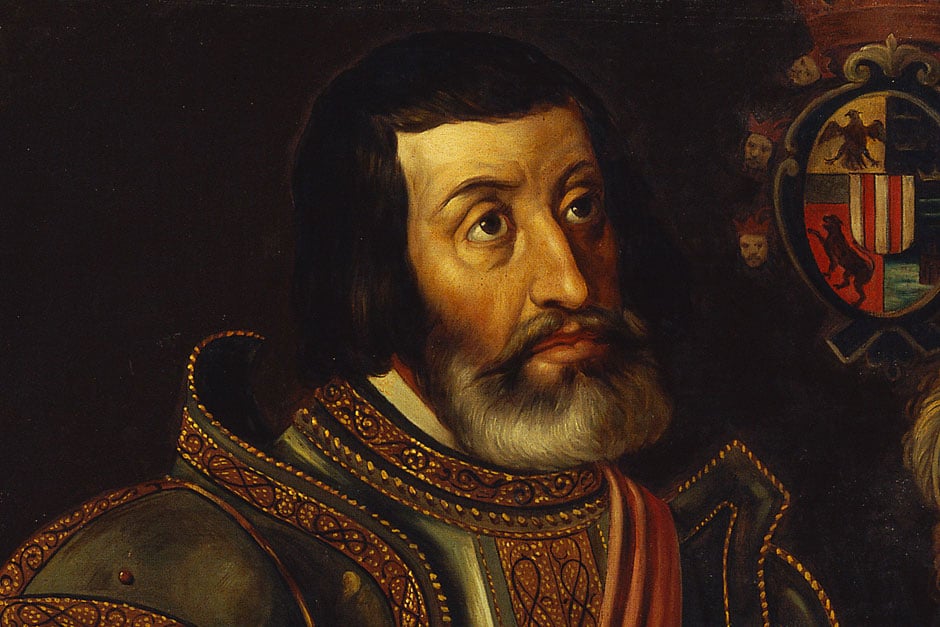
Hernán Cortés
Though his achievements changed the course of world history, it’s hard for us to like Hernán Cortés, who died in the village of Castilleja de la Cuesta, just outside Sevilla, on December 2, 1547.

In a campaign of sheer audacity and supreme self-assurance (not to mention brutality), he conquered Aztec Mexico with a tiny force Spanish adventurers.
Perhaps the adjective that best described Cortés is ‘selfish’. Sent by the governor of Cuba to investigate the unknown land to the west, Cortés saw a chance for glory, personal gain, and more. He sired a total of 11 children, five by his two Spanish wives and six by captured Aztec women.
When the Aztec emperor sent a messenger to negotiate, Cortés had the poor man’s hands cut off, to show the Aztecs how tough he was.
For all his faults, his story is one of high adventure, and well worth reading.
Plaza Mayor, Madrid
If you’ve ever spent any time in Madrid, you’ll know the Plaza Mayor, or ‘main square’. Work began on erecting this architectural gem on in the first week of December, 1617.
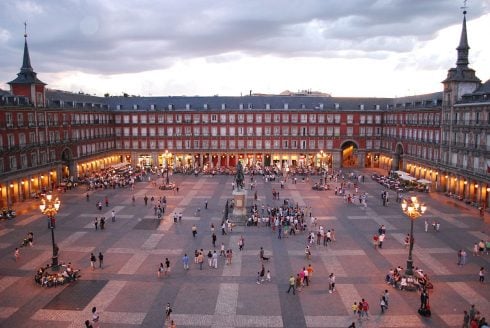
The square has a certain notoriety. The Spanish Inquisition saw its task as stamping out any challenge to the pope’s authority.
The not-very-subtle method it chose was to round up jews, muslims and protestants, and burn them alive in the Plaza Mayor. These barbaric executions were known as ‘autos de fé‘, or ‘acts of faith’.
The statue of a man on horseback which dominates the square is a portrait of Spain’s King Philip III, and was forged by two Italian sculptors in 1616. It was a gift from the Medici Duke of Florence, to thank Philip for rooting out all those non-catholic infidels.
On one of the Plaza Mayor’s entrance ramps, you can find a bar whose name is an ironic comment on stereotypical tourist questions – it’s called, “Hemingway Never Drank Here”!
Primo de Rivera
Franco was not Spain’s only 20th-century dictator. For a year, Miguel Primo de Rivera ruled supreme, surrendering total power on December 2, 1925.

Looking back, it is safe to say that Primo was a disaster. He came from an aristocratic background, and was briefly popular because, as an army general, he was seen as a ‘strong man’.
However, he knew nothing about law or economics, and sought to govern by hunch. His lack of experience and awareness was not helped by his fondness for whiskey.
He surrendered total power and struggled on as “Minister of State” for a couple more years, effectively leading a military junta.
It couldn’t last. The world was in turmoil. Mussolini was causing mayhem around the Mediterranean, and an unscrupulous young rabble-rouser named Adolf Hitler was threatening Europe with chaos.
The final straw was the Wall Street Crash of 1929, which played havoc with the Spanish peseta – and Spain’s economy was all but wiped out,
Primo de Rivera and the generals were brushed aside, but the weak and divided democracy which replaced them would last only five years before the country found itself engulfed in civil war.
Gibraltar Airport
Have you ever flown into, or out of, the interesting little airport of The Rock? Here are some facts you may or may not know about it.
The airport is – clearly – a civilian facility, used daily by the public, but it is owned by the British Ministry of Defence, and operates as RAF Gibraltar.

Dating back to 1936, the airport was constructed because war with Germany seemed likely, and bombers were needed to protect British shipping against the U-boat menace.
Today’s modern airport handles half a million passengers a year. Its main airline was Monarch, until that airline ceased trading eight years ago. Today, Easyjet and British Airways dominate the airport’s civilian traffic.
Gibraltar has been rated the world’s fifth ‘most extreme’ airport by the History Channel, because it has a very short runway and is sometimes seriously affected by crosswinds.
In the first week of December 1987, an inter-government agreement opened Gibraltar Airport to Spanish airlines, but so far Iberia and Vueling have been slow to exploit the opportunity.
Click here to read more La Cultura News from The Olive Press.