

HAVE you ever wondered why they speak Spanish all over Central and South America, except in Brazil, where they speak Portuguese?
It’s Christopher Columbus’s fault!
When the great age of exploration came (1490-1550), both Spain and Portugal were ideally-placed to lead it.
They both had people with seafaring skills, and they both face west, towards the open ocean.
Things worked out neatly at first, because Spain wanted to concentrate on ‘Cipangu’ (Japan) and Portugal was interested in India. However, they were fated to clash.
Whenever you find yourself wondering why humans do things, just follow the money.
It explains everything.
Since Marco Polo, three centuries earlier, Europeans knew that there were advanced societies, somewhere to the east of Turkey.

Those societies possessed wonderful things like silk, curry and precious metals – and heaven only knows what else!
Silk is, even today, a valuable luxury product.
It’s great to wear in summer, it always looks good, and it feels better against the skin than wool, which was the standard material used in European clothing.
Gold and silver are attractive to touch and to look at, and just about impossible to destroy. (You don’t lose your fortune if your house burns down!)
Precious metals are a safe, convenient and appealing way for rich people to hoard their wealth.
Imagine owning a pig. You are, of course, looking forward to killing it and eating it, but until that special day comes, you have to care for it (healthy pork is fresh pork)!
When you butcher it, you’ll have to eat it fast – there were no fridges or freezers in the Middle Ages, and meat goes ‘off’ very rapidly.
Curry enables you to keep eating your pork, even after it has ‘turned’.
All of these goods were small and light, and if a way could be found to bring them back to Europe, they could be sold for a lot of money.
The trouble with sending merchants to Africa or the Far East was, the round trip took months – and there were many robbers along the way.
But if ships could be used, instead of mules …
The Portuguese were making progress, ‘feeling’ their way around the African coast.
And an Italian guy named Columbus was persuading the Spanish royal family to invest in his plan to reach the East by sailing West.
In 1492, Columbus pulled it off.
He took three ships to the Caribbean (he still thought it was Japan) and came back safely.
Unfortunately, he arrived in Lisbon. He told the Portuguese royal family about what he’d found.
He should have kept quiet. As we’d say today, he ‘blabbed’.
Now Portugal took an interest in the Atlantic route.
Over the next 15 years, Columbus led another three expeditions to ‘Cipangu’.
By the end of his career, people were making a lot of money – and Spain and Portugal were stepping on each other’s toes.
Both nations turned to the Pope. Being Catholic countries, they respected his authority, so they asked him to rule on who owned what.
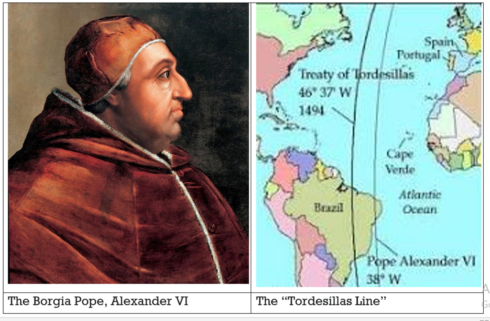
Alexander VI was probably not many people’s idea of a perfect spiritual leader.
Roderick Borgia ruled in the Vatican from 1492 to 1503.
He bribed his way to the papacy, fathered several children via a string of lovers, and shamelessly advanced the career of Cesare, his murderous son. It is even alleged that he slept with his own daughter, Lucrezia.
But he was Spanish. Both royal courts knew him and trusted him.
By the Treaty of Tordesillas (7 June, 1494), he drew a north-south line which ran from the middle of the Atlantic, down to Antarctica.
Everything east of the line, he ruled, was the property of the Portuguese. Everything west of it was Spanish.
It worked.
The only bit of South America that fell to Portugal was the largely-unexplored rain forest which later became Brazil.
Through local wars and subsequent treaties it expanded in size, but it remained Portuguese until independence, at the close of the Victorian age.
That is why twenty-odd countries in South and Central America speak Spanish, and only one speaks Portuguese!
Click here to read more Spain News from The Olive Press.