

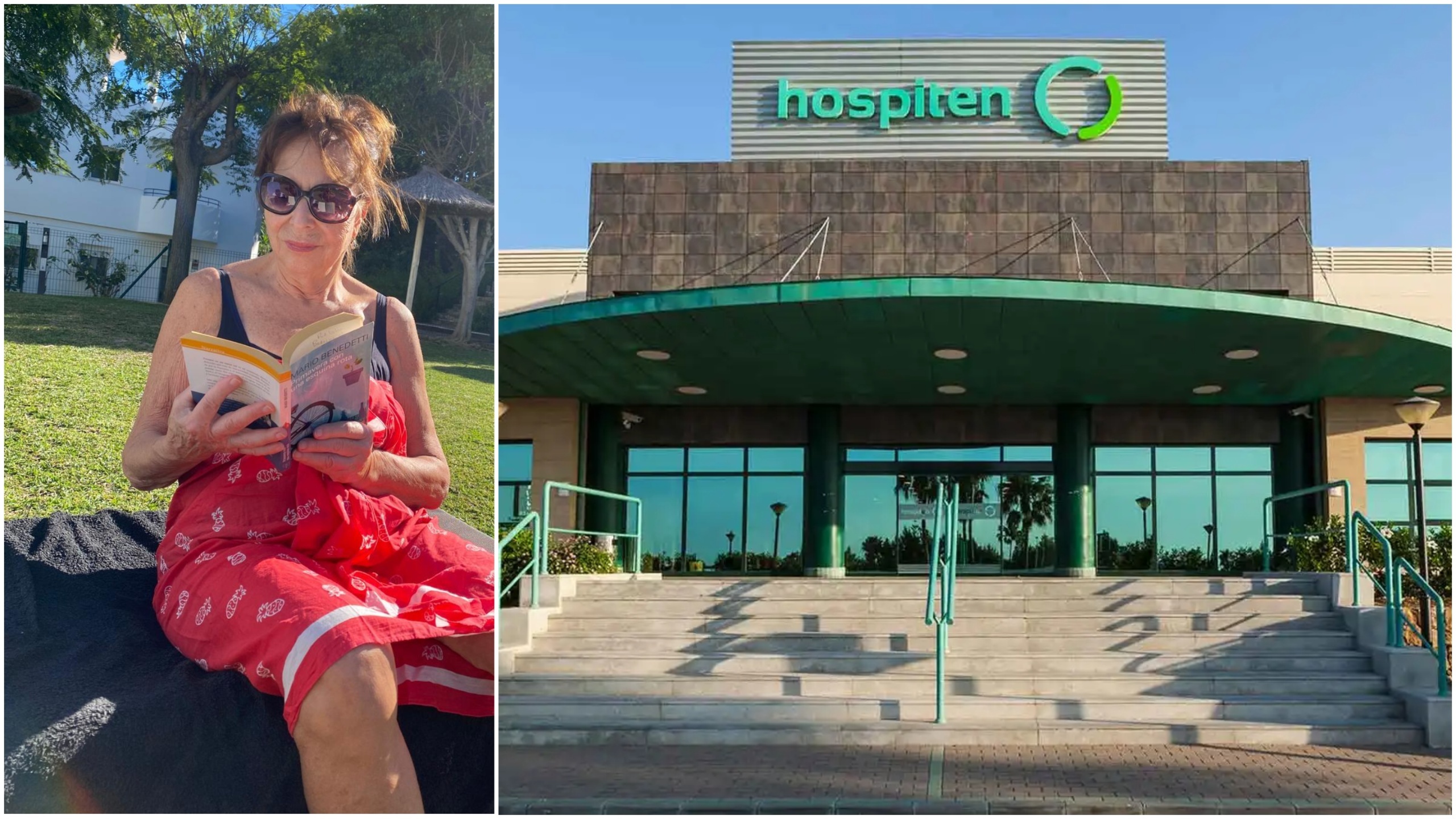
By Rod Usher
Unlucky Angela still has disabling chronic pain a year after knee surgery. In a personal medical saga, her husband, seasoned journalist Rod Usher forensically asks some probing questions about healthcare and insurers in southern Spain
FIRST, not all knee replacements go badly; something like 90% go very well. After initial pain, most recipients are happy.
But when things go wrong…
However, what follows is not an account of medical negligence, something I first encountered as a young reporter covering an inquest after a woman died because a surgical swab was left inside her in theatre.
No, this is a modern tale of what I see as greed, rudeness, and lack of transparency. The players: my wife, Angela, Hospiten, in Estepona, and Asisa, in Málaga.
Angela had a knee replacement nine years ago, when we lived in Extremadura.
Apart from non-stop pain, the prosthetic knee had problems. Back to theatre (funny name for such a grim place!).
A replacement knee was required. These interventions were two years apart at Clideba/Quirón, in Badajoz.
READ MORE: Measles scare in Spain as cases doubled last year – and were virtually zero in 2023
Worse news: the knee was infected, either in the first or second op, by a variant of staphylococcus bacteria.
No one could say how/why. Angela was bombarded with really heavy antibiotics intravenously, but these bugs rapidly build a plastic-like film so antibiotics can’t touch them.
Meanwhile, we moved to live near Estepona. The second knee had to come out, too.
Infected limbs are specialist territory, a select few surgeons in Spain do them. In part because of a technique called debridement, a term meaning how much stuff you must cut away. Don’t worry, no gory details follow.
We sought opinions: a surgeon in Madrid, one in Barcelona, one from a world-ranked authority in Cardiff. They don’t work with insurers, but all three said, this being third-time-round, Angela would have to have a cono or two.
These are metal cones that can be put at the end of the femur or tibiabone to reinforce them after so much chopping.
We found a surgeon at Hospiten, Estepona, Dr Fabian Poletti. He struck us as honest when he said he’d need the counsel of an expert, plus he is known to the world authority in Cardiff. We continue to trust Dr Poletti, who no longer works at Hospiten.
Expert in hand, Dr Poletti replaced the infected second knee with a third. That was in Hospiten in January last year.
Today, exactly a year later, Angela still has disabling chronic pain in her leg and foot, but the knee is no longer infected, and she can bend her leg more than she could after the second one.
That’s a compressed account of nearly a decade of knee trauma.
With the third knee, another drama began.
Angela has been with insurers Asisa since 1996. I dropped out a few years ago because we are old and retired, and my general health is better than hers. I rely on the public system. Yes, I know, a big gamble in today’s Andalucia.
The first two knee replacements in Badajoz were covered fully by Asisa, as you’d expect.
But before Dr Poletti started cutting, we were told by Hospiten that Asisa would not cover the cost of cones.
Never mind that three eminent surgeons told us they might be essential for someone who’s had so much surgery on the same body part.
We paid Hospiten €5,940 for three cones that were ordered.
Dr Poletti in the end needed just one cone, on Angela’s tibia. The other two were returned immediately to the maker, Waldemar Link, which has an office in Barcelona.
Naturally, we asked Hospiten for a refund which we worked out as €3,960 for two unused cones? We also asked for a factura desglosada, an itemised bill.
Hospiten returned exactly €2,000, and a bill reporting; 1 cono femoral (it was tibial) and 1 Palamix cement.
It appeared we were shortchanged, but an itemised bill from Hospiten accounts was never forthcoming, no matter how many times I asked.
The way to get an answer had to be going to the top, the director, Sñr Gerardo Bravo Chaparro. I hand-delivered a letter to him on April 4. No reply. I sent him a certified letter on June 4. Total silence.
The question became, as any unpaid tradesperson knows, is it worth employing a lawyer? Going to court for €2,000 is, at best, a form of Russian roulette, played very slowly.
However, due to the sheer rudeness of Hospiten’s silence and refusal to provide an itemised bill led me to take a deep breath and contact a lawyer recommended by our bank manager.

The lawyer wrote. The same silence continued. Finally, he pointed out certain aspects of the Penal Code to Hospiten’s compliance/legal centre, which is in Tenerife.
After further delay and more letters, he received a reply, presumably drafted by the legal office, from Sñr Bravo. His letter is dated October 13, nearly nine months after Angela’s operation.
The letter offers what to me is a limp apology for the ‘inconveniences’, blames Dr Poletti for ‘the confusion’, says Hospiten doesn’t recognise any error in the billing…but will return us another €500.
(Which it has now done. Why, if all was clear and correct?) His letter neglects to mention billing for a cone on Angela’s femur when the one used was for her tibia, an error I found scary.
Where was this ‘confusion’ caused by Dr Poletti? He answered all medical questions we had before and after the operation. At our request, he provided the protocol document showing the cone used is tibial, not femoral. X-rays confirm this.
We found Dr Poletti extremely caring. He told us several times that billing is not the surgeon’s business.
I asked our lawyer for two more things. Hospiten should pay his own costs, and we should get an itemized bill. They paid half his costs, and… provided a factura desglosada. A real bill!
Surprise, surprise, it now totals €3,440, which fits with Hospiten paying us the €500 Sñr Bravo implied was generosity.
With the bill in hand, the mystery deepens. Instead of just one cone for €1,980 the bill now has three additional items supposedly not covered by Asisa. (I tried but failed to get Waldemar to reveal what they charge a hospital for a cone. I have an idea it’s about €1,500).
The additional items on the bill are: ‘Component femoral y tibial, €574,31; Cemento Palafix, €754; Tapon distal, €131,69.’ Add the €1,980 for the one cone: €3,440.
READ MORE: Man dies in bedroom after cliff rock crashes down onto his seaside Menorca home
I make no suggestion Hospiten has done anything illegal, but was this final accounting – so many months later – produced only because I engaged a lawyer?
Now, the medical insurer part. In Angela’s case, Asisa. Why, if in the first two operations all was covered, is it not now?
How can Hospiten bill us €754 for antibiotic cement? Asisa knows that if you don’t put cement into a new knee, well, it will pull out, with disastrous effect.
Why were the other two additional elements in Hospiten’s new bill not covered?
Writing to Asisa Málaga feels like writing to Sñr Bravo. I wrote to the company last January, ten days before Angela’s operation, challenging its policy not to cover cones. If two of Spain’s leading surgeons for post-op knee and hip infections say you need cones, if a world authority based in Wales (who helped invent the cones) says the same thing, how can an insurer not cover the cost?
One year later, still no answer to that letter.
Maybe Asisa would argue, if it cared to reply, that a cone attached to a bone is not part of a prosthetic even though the artificial knee will likely fail without it?
Where lies the benefit of any doubt? Angela has been paying Asisa without interruption since 1996, as her credit card shows.
I shudder to look up that total. Asisa might seek to claim she has cost it more than said total because of her various needs over these 30 years.
But isn’t that how insurance companies work…the healthy people, I mean clients, compensate the provider for the sicker ones?
Ever heard of a medical insurance company going broke?
I suspect Asisa would dearly love to get rid of my wife. We were shocked when the company made a jump of several hundred euros in her premium for 2025 to €4,748.
In December we received advice of the bill Asisa had coming for her for 2026: €6,386. That’s a yearly increase of 25%. Inflation’s now about 3%. What’s more, Asisa has co-pago, meaning every time Angela has a medical appointment there’s a small extra charge. The €6,386 alone breaks down to €122 a week, more than many people can spend on food.
After finally receiving Sñr Bravo’s letter and dragged-out bill I wrote again to Asisa, about their cover/lack of and the new bill. I suspect they would like Angela to opt out, no longer the asset client she was 30 years ago.
I imagine Sñr Gerardo Bravo has reason to be proud of his hospital’s balance sheet. I’m sure Asisa will continue its glossy advertising about care.
What I wish is that governments, especially ours in Andalucia, would stop shovelling money to private operators and deliver the funds, staff and, above all, efficient management, needed by Spain’s once-enviable public health system.
Footnote: At the time of writing, Asisa still hasn’t answered why two knee operations were fully covered but the third at Hospiten was not, leaving us to find more than €3,400. My last mail to them was in October.
After my protests re this year’s bill, someone in Asisa in Madrid (I can’t discover who) must have decided a 25% premium increase was a bit steep. So, Angela’s 2026 bill has been lowered from €6,380 to €5,351, roughly an 11% increase on last year.
The Olive Press contacted both Hospiten and Asisa for comment.
Hospiten didnt respond to our request in writing, however on the phone would only say: ‘Dr. Polletti doesn’t work here anymore’, while Asisa did not provide us with any information, despite replying by email that they would send a letter. After a third email requesting this letter, we were told it would ‘be best’ if we came in person to the head office in Madrid.
Dr. Polletti, confirmed he no longer worked with Hospiten, and sympathised with the patient and her husband’s claim.
“I wish first to express my respect for both Angela, my patient, and her husband Rod,” he wrote. “Throughout the process they were engaged, thoughtful, and cooperative, and I continue to hold them in high regard.
“In complex revision surgery, it is standard practice to request up to two cones pre-operatively due to variable intraoperative findings; in this case, only one was required.
“While working under the Hospiten structure, I had no involvement in pricing, billing, or financial estimates, which are handled exclusively by hospital administration and fall outside the surgeon’s remit.
“Mrs. Usher’s current discomfort reflects the consequences of nearly a decade of accumulated joint damage, not a failure of the surgical procedure – a distinction also acknowledged in the article.”
Rod Usher is an Australian poet and novelist who has been living in Spain for more than 30 years. He is a former chief sub-editor of the Sunday Times in London and a senior writer for TIME magazine.
Click here to read more Health News from The Olive Press.






I have friends who bought a new flat in the Alma development in Estepona. Bought off plan, with a mortgage they have been paying for nearly two years, while still paying for their cramped current flat. They were expecting to move in before the summer, to make the most of a bigger flat with bedrooms for their daughters, and the pool.
So sad. The Alma flat has been costing them, but is now unsellable. Meanwhile the surge in property prices in Estepona means that they can’t buy another place, even if the builder gave back their deposit.
This is all very disturbing. Sorry to hear of this health saga and wish you good health in the future. I was just about to enquire into private healthcare in Andalucia. I was led to believe it was really inexpensive. Wow! Nearly €6000 a year. Yikes!