

Forget Romeo and Juliet. Long before Shakespeare put quill to paper, Spain had its own version of star-crossed lovers in a tragic tale that has been kept alive through the centuries with its very own festival – coinciding with Valentine’s Day.
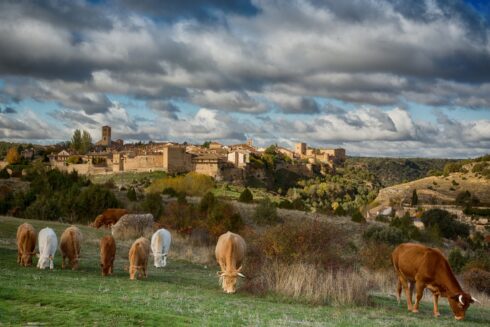
Perched on a hilltop in Aragón, roughly halfway between Madrid and Valencia, Teruel is often overlooked by travellers – and that’s part of its appeal. Its compact historic center invites slow wandering, with quiet plazas, mudéjar towers, and narrow streets that feel perfectly suited to medieval drama.

That drama reaches its peak every year in February, when Teruel stages Las Bodas de Isabel de Segura, a multi-day festival that transforms the city into a living reenactment of its most famous legend.
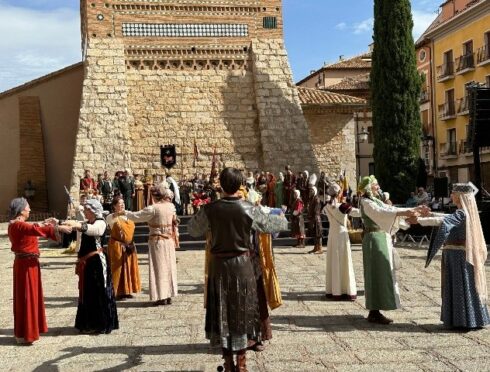
For several days, modern life recedes: residents abandon modern garb in favour of 13th-century costume, banners hang from balconies, and the streets fill with the sounds of drums, lutes, and public proclamations.
The festival follows the tragic timeline of Isabel and Diego’s story, with staged scenes unfolding across the historic centre
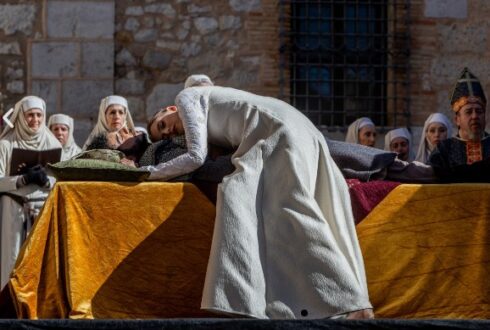
Visitors can watch Diego’s departure to seek his fortune, Isabel’s forced wedding, and the lovers’ final, devastating reunion. Key moments are performed in plazas and church squares, allowing the audience to move through the city as the story progresses—part theatre, part communal ritual.
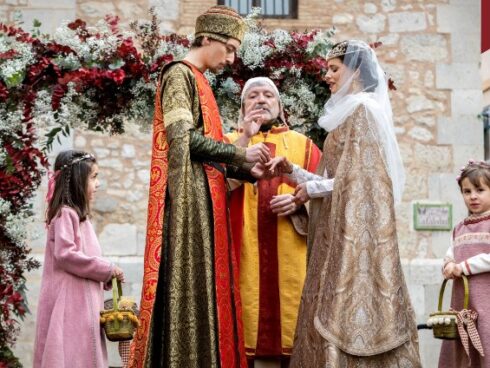
Markets selling medieval-style food, crafts, and local products line the streets, while taverns spill outward with diners sampling jamón de Teruel, stews, and Aragón wines. At night, torchlit processions and candlelit performances lend the city an almost cinematic atmosphere, blurring the boundary between past and present.
At the heart of it all is the Mausoleum of the Lovers of Teruel, where the alabaster tombs of Isabel and Diego lie side by side, their hands nearly touching.

The legend itself dates back to 1217, when two wealthy Teruel families—the Marcillas and the Seguras—fell victim to changing fortunes and rigid social codes. Diego de Marcilla, once wealthy, was forced to leave the city for five years to make his fortune fighting the Moors before he could return to claim the hand in marriage of his teenage sweetheart Isabel de Segura.
When he returned on the very day of the deadline, it was to discover that Isabel had already been married off. He begged her for a kiss, but despite still loving him, she refused on account of being married to another and he dropped dead from a broken heart.
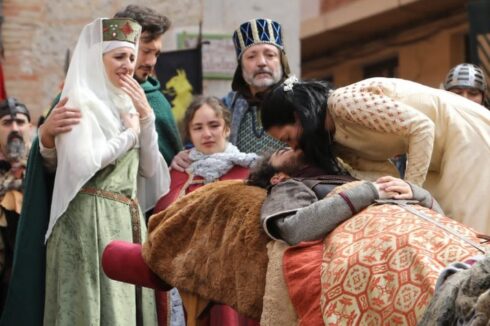
At his funeral and wearing her wedding dress, Isabel flung herself on his lifeless body to give him a final kiss and instantly died from heartbreak. The story has been debunked in recent years with exhumations of the tomb revealing those inside it could not have been the Isabel and Diego of legend, but instead a mother and son.
But the tale remains very much a part of the myth and lore of Teruel itself, making it a magical place to visit in February.
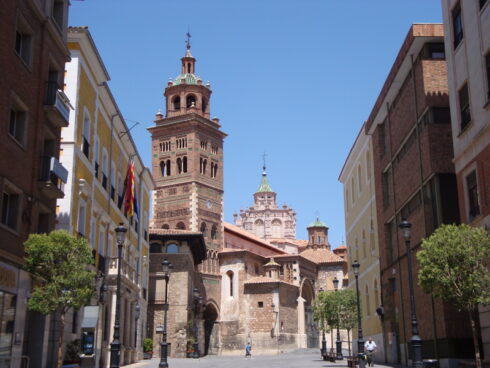
Beyond the festival, the city offers much to explore. Teruel’s UNESCO-listed Mudéjar architecture, including the Cathedral of Santa María and the towers of El Salvador and San Martín, gives the skyline its distinctive character. Visitors can climb the towers, walk the city walls or stroll the cobbled streets of the casco antiguo.
For lovebirds wanting to go beyond the hallmark version of Valentine’s Day, Teruel’s February fiesta is a deep dive into Spanish history and culture.
And what could be more romantic one than participating in the celebration of one of the most enduring love stories in Spain?
READ ALSO:
- Off the beaten track: Five destinations to explore in Spain during 2026
- Discover the four destinations added to Most Beautiful Villages in Spain list for 2026
- FIESTA! The best festivals in Spain for your 2026 travel bucket list
Click here to read more Olive Press Travel News from The Olive Press.