
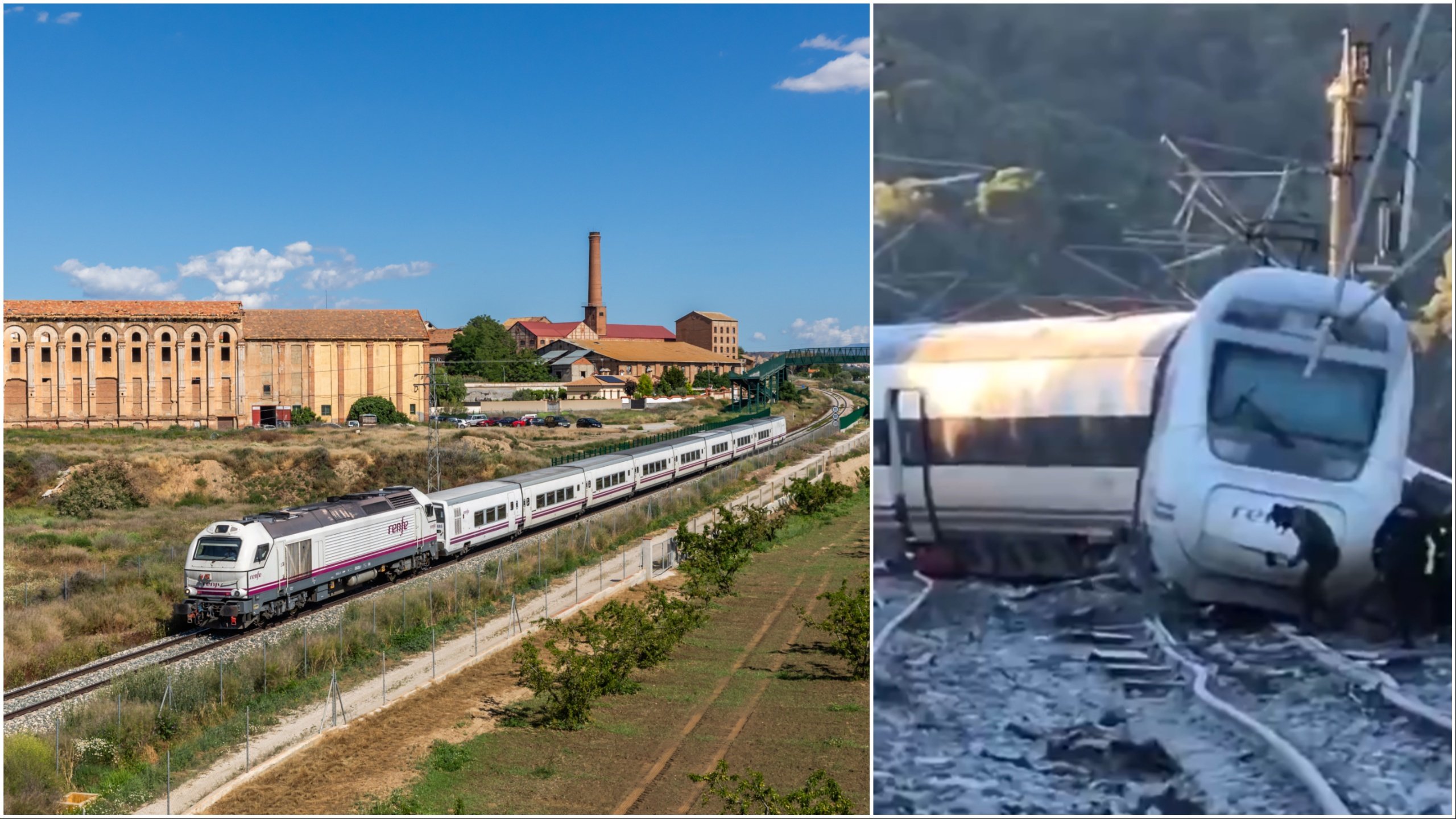
SPAIN has been plunged into travel chaos after train drivers began a three-day nationwide strike in response to a spate of deadly accidents on the country’s rail network.
Over 350 high-speed services have been cancelled until Wednesday as Semaf, the train drivers’ union, demands increased investment and maintenance in what it has slammed as ‘the constant deterioration of the rail network’.
Commuter routes have also been impacted, with trains operating at minimum service levels of between 75 per cent at peak times and 50 per cent during off-peak hours.
The guarantees are lower in Catalunya where the region’s Rodalies commuter network is running at between 33 per cent and 66 per cent of normal capacity.
The strike was called by some of the country’s biggest trade unions including Semaf, the Workers Commissions (CCOO), the General Workers’ Union (UGT) and the General Confederation of Labour (CGT) after Spain was rocked by a string of fatal train crashes last month.
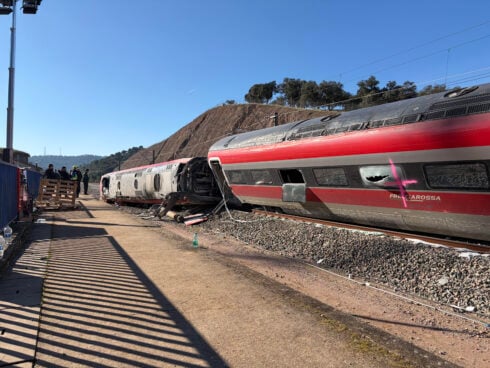
On 18 January, two high-speed trains derailed in Adamuz, Cordoba in Spain’s deadliest rail accident since 80 people were killed in Santiago de Compostela in 2013.
Some 46 people were killed and hundreds injured after the rear carriages on a Madrid-bound Iryo service carrying over 300 passengers flipped onto an adjacent line and collided with an oncoming train destined for Huelva.
A preliminary report published by the rail accident investigation commission suggested that the crash was caused by a 30cm fracture in the track.
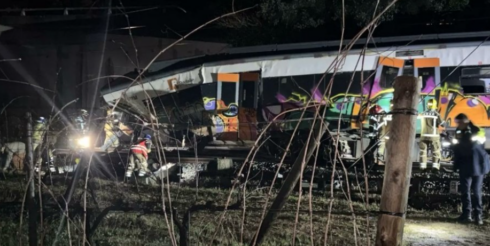
Two days later, a train driver was killed and over 40 passengers hurt on Barcelona’s Rodalies network after a R4 line service came off the tracks between Gelida and Sant Sadumi.
The train derailed after colliding with a retaining wall that collapsed onto the line following a spell of heavy rain.
Two days later, six people were injured in Cartagena, Murcia after a passenger train collided with a crane arm that swung onto the track.
The spate of accidents have raised urgent questions about the state of infrastructure on Spain’s rail network – often hailed as one of Europe’s best – and intensified pressure on government figures including transport minister Oscar Puente.
Union representatives are set to meet with officials from the transport ministry later today in an attempt to thrash out a deal on improving maintenance across Spain’s rail network.
“The moment we obtain what we are demanding, we would sign the agreement, but it is a complex issue given the measures that would have to be implemented,” a representative for Semaf said.
But tensions have risen between the two parties over the minimum service levels set by law to keep the network running during industrial action, with the unions criticising the requirements as ‘abusive’.
Some 75 per cent of commuter trains must run during peak hours, dropping to 50 per cent for off-peak time slots.
For medium-distance trains, 65 per cent of normal services must run, while 73 per cent of services on the high-speed network must take place.
The transport ministry say these minimum levels are imperative to ‘guarantee essential services and unavoidable journeys for the public, while balancing this with the right to strike’.
Under EU law, passengers who have a train cancelled due to strike action are entitled to a full refund within 30 days.
Alternatively, you can change your train at no additional cost.
Click here to read more Spain News from The Olive Press.