FOR a century, it has been a local laughing stock. A ‘Ghost Dam’ that held no water, a monument to a Swiss engineer’s spectacular oversight.
But nobody is laughing now.
Right now, in the relentless wet winter of February 2026, the Montejaque Dam has finally done what it was built to do: It has filled up.
And for the families currently sleeping on gymnasium floors in Ronda, evacuees from the valley below, the joke is officially over.
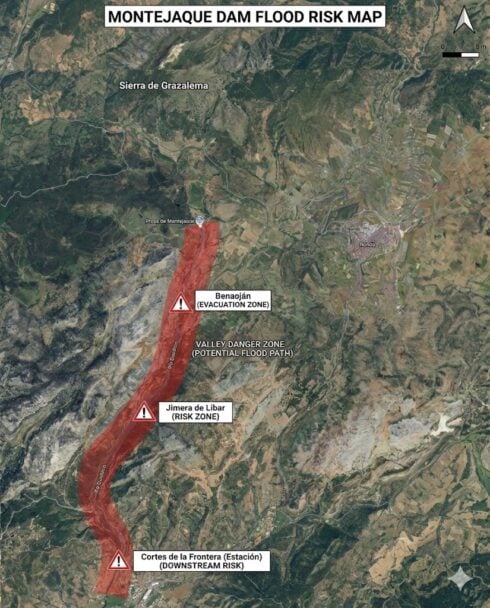
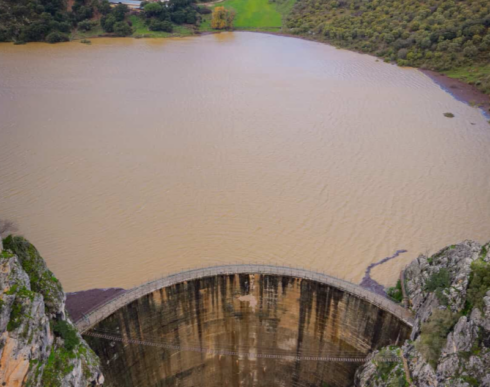
The dam, sitting in the hills above Benaoján, is currently holding back millions of gallons of silt-brown water.
The subterranean caves that usually drain it are waterlogged, and the level is rising.
It is a terrifying sight. But it is important to separate fear from fact.
While the water ominously laps just centimetres from the rim, authorities have been quick to reassure the public that the structure itself is not going to fail.
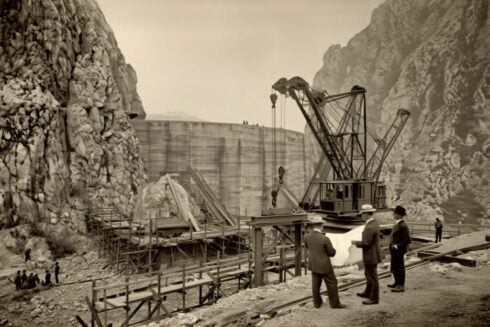
When Swiss engineer Grüner built this ‘wafer-thin’ double-curvature arch 100 years ago, he produced something cutting-edge. It was a masterpiece of tension and geometry.
Despite its age, experts insist the concrete wall is more than strong enough to hold back the weight.
The dam won’t break. But the levee might just overtop.

The Limestone Flaw
Grüner’s genius overlooked one small, geological detail. The entire Montejaque-Benaoján district sits on porous limestone.
For 100 years, whenever it rained, the water simply bypassed his expensive wall, filtering through the ‘Swiss cheese’ rock and draining into the vast cave systems underneath.
Instead of providing the precious liquid Andalucía needed for drinking and hydro-electricity, the dam stood empty—a dry, concrete amphitheatre in the mountains.
Until now.
The sheer volume of rain this winter has overwhelmed the earth’s natural plumbing. The caves are full. The sponge is saturated. And so, the Ghost Dam has risen from the dead.
The Railway Connection
To understand why this is such a threat, you have to look back even further than Grüner, to the late Victorian era.
When British engineers built the Bobadilla-Algeciras railway—one of the world’s most spectacular lines—they faced a problem.
Andalucía is stubbornly mountainous, and trains don’t do hills. They need shallow gradients.
The solution? Build the tracks on the valley floors and flood plains.
This is why stations like Cortes, Gaucín, and Benaoján were built miles from their hilltop pueblos. And where the stations went, communities followed.

Pleasant hamlets like Estación de Benaoján grew up around the tracks, neat little societies straddling the river and the rails.
They are organic, thriving communities. On one particularly wet winter about 15 years ago, a little old English lady in Estación woke up to find the River Guadiaro had filled her swimming pool with malodorous mud.
Juan, a local bloke, turned up with a shovel and spent a week restoring it to pristine condition. He didn’t ask for money. He did it because that’s what neighbours do. That is the spirit of Estación.
Waiting for the water
Today, that spirit is being tested. The entire community has been evacuated.
They are leading a difficult existence in unfamiliar surroundings, hoping against hope that the water recedes or spills over gently in a ‘controlled overflow’, rather than surging down the valley in a torrent that could swamp their homes.
In the 1970s, Led Zeppelin reworked an old blues song, When the Levee Breaks.
It tells of a torrential rain that undermines everything people hold dear, and the helplessness of locals watching the water rise.
“Crying won’t help you, praying won’t do you no good.”
In the southern US states, the fear was that the earth walls (levees) would crumble.
Here in the Guadiaro valley, the concrete wall will stand firm.
But as the water creeps higher, the people of Estación de Benaoján are praying that the useless old dam doesn’t prove everyone wrong in the worst way possible.
Click here to read more News from The Olive Press.