
ALL eyes in Madrid’s Puerta del Sol were locked onto the boy – some mirthful, some scornful and some merely curious.
Wearing a white wolf mask and a tattered hoodie, the boy lowered into a crouch as onlookers formed a circle around him.
Then he stretched, dropped onto all fours, and took a few tentative steps as laughter rippled through the crowd.
The teenager was one of a small number of therians who met in cities across Spain last weekend.
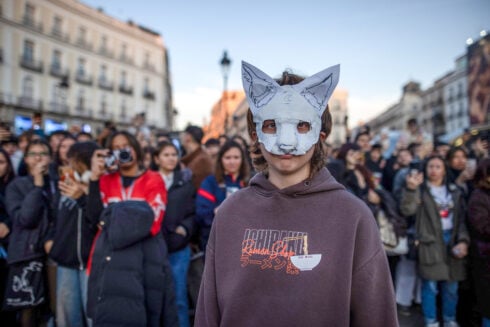
The meet-ups drew thousands of curious bystanders eager to watch – but in reality hijack – the strange event, which was intended for a new subset of masked teens.
In the end, their own turnout was meagre; a handful of therians in Madrid, even fewer in Segovia and Salamanca – and none in Barcelona.
But that did not dissuade thousands of spectators from showing up at the Catalan capital’s famous Arc de Triomf. It was a dangerous mix of loitering youths who had to be moved on by local police before trouble broke out.
For those who had anticipated a spectacle – or the chance to jeer at young animal cosplayers – the scenes were largely a let-down. In reality, there was never much substance to begin with.
Therians are people who identify with animals. In the words of Fin, a 17-year-old Barcelona native interviewed by EFE last week, they describe feeling a spiritual connection with the animal of their choice – whether a wolf, an owl, or a Belgian Malinois.
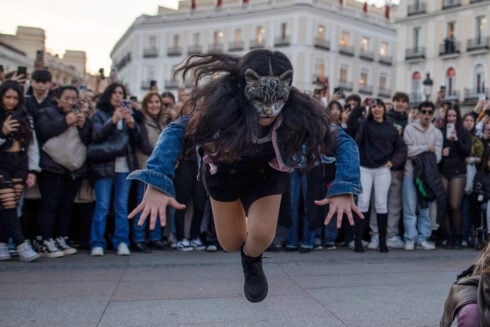
In practice, this often means wearing animal masks and props while mimicking animal mannerisms: walking on all fours, baring masked ‘maws,’ or howling for effect.
Yet, they do not literally consider themselves anything other than human, Fin said – and certainly, they are far fewer in number than recent viral trends on social media might suggest.
Algorithms on TikTok and Instagram have helped push the phenomenon into the spotlight. The logic is simple: the more clicks and reactions a post receives, the more frequently it appears in users’ feeds.
READ MORE: 36 Hours in Avila: Discover Spain’s medieval walled masterpiece on the plains of Castilla y Leon
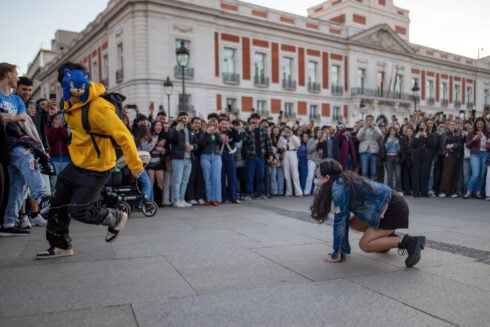
Early this month, short videos of masked youths began spreading rapidly across Spanish social networks.
Clips filmed in parks, plazas and shopping centres amassed huge view counts, often paired with captions suggesting that ‘therians are everywhere.’
The same fragments of footage were reposted repeatedly, creating the impression of a fast-growing craze.
Offline, however, the picture looked very different. Widely publicised gatherings in Madrid, Barcelona and other cities revealed only small numbers of masked participants, typically surrounded by far larger crowds of spectators.
What seemed online like a mass phenomenon translated in reality into a handful of curious teens and many more people filming them.
As attention grew, so did misinformation. Among the most widely shared claims was the false suggestion that the Spanish government was considering a monthly €426 subsidy for people identifying as therians – a hoax that spread hand in hand with AI-generated videos of therians attacking innocent bystanders.
Predictably, the episode soon took on a political tone. Certain commentators and accounts seized on the viral clips as supposed evidence of social decline, folding therians into broader culture-war narratives.
The tiny, loosely defined subculture became an easy punchline and a convenient symbol in debates that had little to do with the individuals themselves.
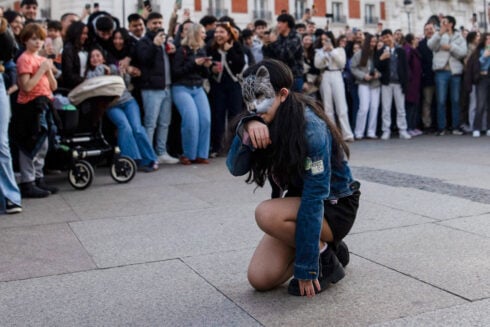
The experiences of young people caught up in the storm reflect this shift. Gabriela, a 15-year-old behind a fox mask in Madrid, said she came to Puerta del Sol hoping to meet others like her.
Instead, she found herself overwhelmed by mockery from an unwelcome crowd intruding upon what was meant to be ‘her first gathering with people like me.’
Onlookers shouted at her to jump against her will, surrounding her in a circle while recording her on their phones.
Most of the crowd were influencers trying to create viral content and hundreds of teenagers who had come just to watch and mock the event.
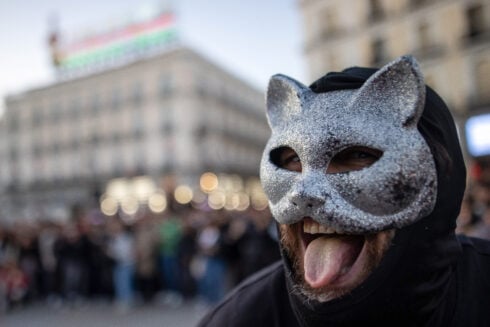
By the time the weekend meet-ups took place, expectations had been inflated far beyond reality.
Crowds gathered, phones raised, anticipating scenes that never truly materialised. The mismatch was stark: a viral sensation built largely on repetition, speculation and algorithmic amplification.
In the end, the therian ‘boom’ in Spain revealed less about a surge of animal-identifying youths than about the mechanics of online attention.
A scattering of videos became a national talking point; and, almost as quickly as it emerged, the spectacle began to fade.
Click here to read more Madrid News from The Olive Press.