


SPAIN is currently the darling of Europe.
Its economy grew faster than any G7 nation last year, unemployment is steadily falling, and Pedro Sanchez’s government has wasted no time in trumpeting a booming economy.
It has even been hailed as the poster child for the entire western world, one which Spain’s neighbours have been facing stagnant growth and economic decline.
But for many – if not most – people living here, none of this seems to reflect the reality of their lived experience.
READ MORE: Spain has become Europe’s standout economy, according to the FT
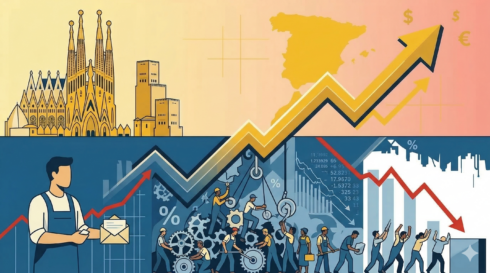
That’s because, if you scratch beneath the polished surface of this macroeconomic miracle, a sharply different – and divided – picture emerges.
If you are a retiree drawing a state pension or foreign income – especially if you are benefiting from a strong pound or dollar – you are likely sitting comfortably.
But if you are of working-age, slogging it out on a Spanish employment contract, you will find you are trapped in a very grim reality: stagnant wages, a soaring tax burden, and an out-of-control housing market.
The cold, hard numbers from Spain’s National Statistics Institute (INE) make for sobering reading.
While the macroeconomic data is real – inward investment is up, tourism is breaking records, and employment has reached historic highs – almost none of this is making it into workers’ pay packets.
READ MORE: ‘Tourism is no longer the main driver of the Spanish economy’ as growth figures are halved

Wage woes
Average gross wages have risen by a microscopic 0.2% in real terms since 2018 – a period spanning a global pandemic, a historic inflation crisis and what has been described as an economic renaissance.
It means the average Spanish worker is earning almost exactly what they earned seven years ago.
Worse still, what workers actually take home – net pay after income tax and social security – has dropped by 3.4% over the same period, with the difference swallowed by a 4.8% rise in employee-side tax and social contributions.
Meanwhile, employer-side social security contributions have jumped 15.4% in real terms.
The Spanish state has quietly absorbed the cash that workers might reasonably have expected to pocket and employers might have totted up as profit.
Everybody is paying more, but nobody is taking home more – with one keen exception, since much of this increased taxation has flowed directly into retirees’ pension pots.
Productivity tells the same story. Despite the impressive growth figures, output per worker has actually declined 1.2% in real terms since 2018.
Spain’s economy is not booming because it is becoming more efficient or more dynamic.
In fact, once immigration figures are taken into account, it is hardly booming at all.
READ MORE: Spain flies past both South Korea and Japan in GDP rankings as service economy is now king
Migrant mirage
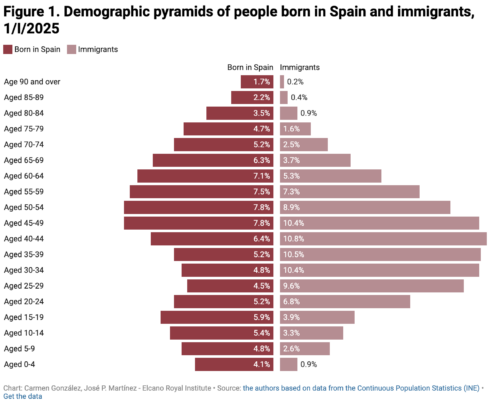
Which brings us to the most striking figure of all – a huge proportion of the new jobs being created by the growing economy are being gobbled up by foreigners, according to a new report from the Elcano Royal Institute.
Up to 90% of all new jobs created between January 2024 to March 2025 were filled by immigrants, who earn an average taxable income €532 per month less than that of native Spaniards.
Spain has absorbed a net average of 600,000 immigrants per year since 2022 alone, with every single person added to the population so far this century being because of immigration.
The native birth rate stands at a paltry 1.1 births per woman – enough to see population collapse in just four generations.
READ MORE: Why Spain’s economy will ‘keep on shining’ in 2025, according to experts at Oxford Economics
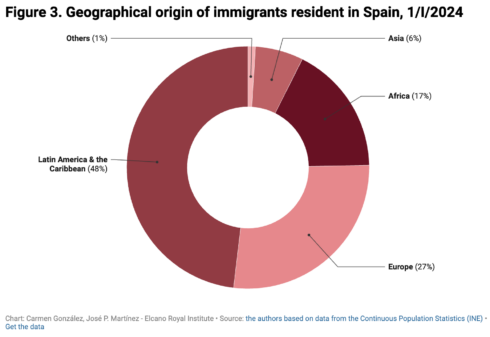
Instead, Spain’s immigrant population now stands at 9.38 million – 18% of the total population, with the vast majority coming from Latin America.
These workers are overwhelmingly concentrated in low-wage, low-productivity sectors: 71% of domestic service workers are immigrants, as are 45% of those in hospitality, 32% in construction and 31% in agriculture.
The result is an expanding economy, but with average wages anchored to the floor by the heavy concentration of low-paid jobs at the base.
READ MORE: Spain’s economy will grow more than early forecasts expected in 2025 according to the IMF
Property poverty
On the other side of the coin, Spain’s property market has been stratospheric for a couple of years now, with average house prices surging by a staggering 29.2% in real terms since 2018 – in the same period take-home wages have actually decreased.
It means that the gap between earnings and buying one’s first home has become practically unbridgeable without significant generational generosity.
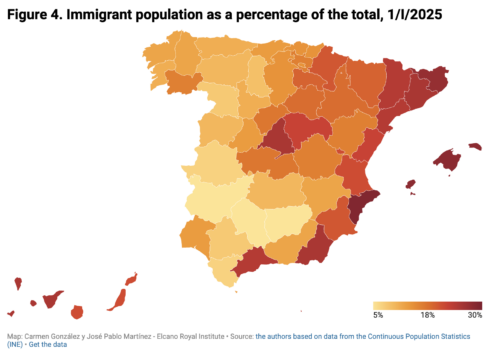
Instead, wealthy foreigners from northern Europe and North America have moved in, happy to meet the inflated asking prices and, in turn, creating virtual expat colonies in some of the most desirable regions along the Costa Blanca and Costa del Sol.
Spain’s 2023 Housing Law has done nothing to arrest the upward trajectory, with many blaming its landlord-unfriendly policies for further exacerbating the problem.
The winners take all
There is, however, one demographic for whom the state has delivered generously.
Even as house prices have rocketed and wages flatlined, retirees – who generally need to worry about neither – have basked in an average state pension rise of 16.4% in real terms since 2018.
Such generosity followed a deliberate political decision to bin caps on pension increases which were as low as 0.25%, and link them directly to CPI inflation instead.

Just as the cost-of-living crisis was taking off in the wake of Covid and the Russian invasion of Ukraine, Spain’s pensioners were enjoying payment hikes of 2.5% in 2022, 8.5% in 2023, 3.8% in 2024, and 2.8% in 2025.
So, how has Spain managed to post near-3% growth figures if wages and productivity have actually dropped since 2018?
Because GDP growth is an average, and averages conceal as much as they reveal.
Behind Spain’s dazzling headline figures lies an economy in which workers have seen their real purchasing power eroded, homeownership is out of reach for a new generation, and the growth itself has been built on a vast wave of low-wage immigration that keeps the engine running without ever quite sharing the fruits.
Spain’s economy is not becoming more advanced or more efficient; it is simply getting bigger because so many people are migrating to the country.
Click here to read more Business & Finance News from The Olive Press.







The winner takes all suggests pensioners and the Spanish tax department are the only winners but I’m sure there are companies making profits on the back of workers. It would have been interesting to see a breakdown of profits but sector and the increase in wealth.
It seems that the only way to make a little profit as a small business in Spain is by exploiting immigrants and consistently underpaying them.
Hi Flora
Thinking about it that is a really good point… And I’m sure 99% of our readers would agree that it’s almost impossible to make a decent profit here and not pay for too much tax.