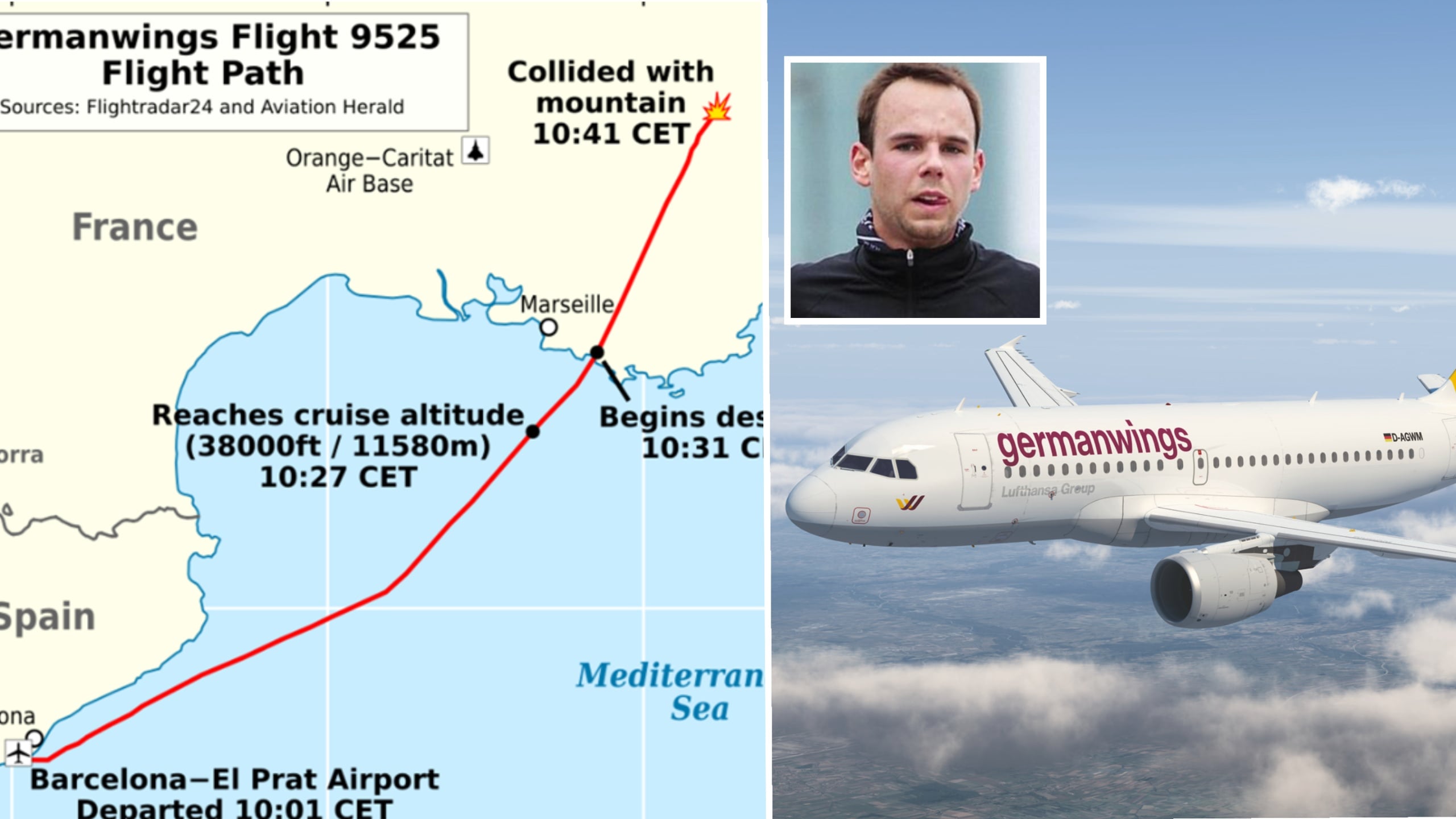
ON March 24, 2015, a commercial flight between Barcelona and Dusseldorf crashed into a French mountain.
A total of 150 passengers and crew lost their lives, of which 72 were German and 50 were Spanish.
It is well known that accidents can happen, and we agree to take that minuscule risk when we buy our tickets.
But this was not an accident – as one man aboard the Airbus deliberately caused the disaster.
If you are a nervous flyer, pour yourself a stiff drink before reading on.
When the Airbus 320, operating as Germanwings Flight 9525, took off from Barcelona on Tuesday, March 24, 2015, everything seemed routine.
Captain Sondenheimer, who would last be heard banging on the door of the cockpit demanding to be let in, was in charge.
And his co-pilot was a young German name named Andreas Lubitz.
Lubitz was an odd young man who was 27 years old at the time of the crash.
He was born in 1987 and had been raised in Neuburg, Bavaria.
Aviation was an obsession with him, and he learned to fly at a sports club in Montabaur, though he did not make friends easily.
In November 2008 he moved to Bremen, where he entered the Lufthansa pilot-training programme.

Ominously, he dropped out after a few months, suffering from ‘severe depression’.
A psychiatrist certified him as fit to continue in August 2009, and he rejoined the course.
A year later he was in Arizona, in the United States of America, where Lufthansa maintains a ‘finishing school’.
It took him a further three years to obtain his commercial pilot’s licence, during which time he made his living by working for Lufthansa as cabin crew.
Finally, in June 2014, he was taken on as ‘first officer’ by Lufthansa’s no-frills subsidiary, ‘Germanwings’.
But his clinical depression had not gone away, even if for the moment it was in remission.
Little were the 144 passengers on board Germanwings Flight 9525 to know this, including a party of high school students returning home after an exchange visit to Catalunya.
READ MORE: ON THIS DAY: The Madrid train bombings – how Spain’s worst ever terror attack unfolded 22 years ago
It was slightly after 10am in the morning, and everyone expected to be in Dusseldorf for lunch as the cabin crew distributed snacks and newspapers.
Evidence from Air Traffic Controllers and from the ‘black box’ recorder makes it clear that, in the early phase of the journey, Lubitz was courteous and deferential towards the captain.
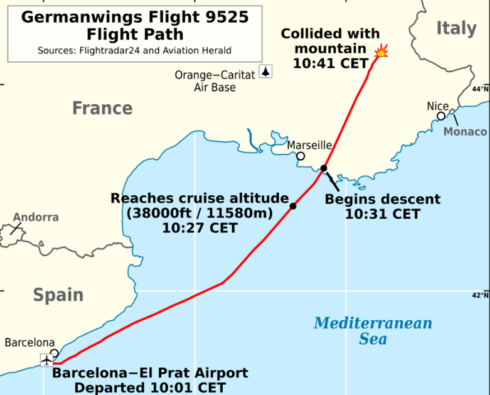
However, as the plane reached cruising altitude over the Mediterranean, his manner became ‘abrupt’ and ‘curt’.
We know now that Andreas Lubitz was suffering another bout of depression and had decided to take his own life.
By his own twisted logic, the ‘only’ way to die was at the controls of ‘his’ plane, and he had a plan.
The route to Dusseldorf would take Flight 9525 over southern France, specifically the western foothills of the Alps.
It would be very difficult for emergency services to reach the scene of a mountain crash, and Lubitz wanted to eliminate all chance of being rescued.
He also knew that, since the terrorist attacks of the previous decade, it was standard practice for the flight cabin to have a lockable door.
If he could induce the skipper to leave his post, perhaps for a toilet break or maybe to chat with the four cabin-crew members, Lubitz could lock himself in and the whole plane would be at his mercy.
Captain Sondenheimer started his mid-course briefing as the plane entered French airspace, just to the east of Marseilles.
He commented on Lubitz’s ‘unresponsive’ manner.
When the captain broke off to pay a visit to the onboard toilet, Lubitz seized his chance and locked the flight cabin.
When Sondenheimer tried to get back in, he could not.
His angry voice can be heard on the flight recorder, ordering Lubitz to open the door, but it was no use.
The plane began to descend steeply.
Over the next eight minutes, it lost 30,000 feet of altitude (9,144 metres), crashing into a mountain to the north-west of Nice at 10.41am in the morning.
Everyone onboard was killed.
The obvious question is why a man, living under the shadow of such severe depressive illness, was ever allowed near the controls of a commercial aircraft.
It should be stressed that such situations are exceedingly rare.
However, it is worth reflecting that life requires us, sometimes, to entrust our lives to other human beings.
All we can hope is that training, and a strong professional ethic, will reduce our chances almost to zero of ever encountering another Andreas Lubitz.
Click here to read more La Cultura News from The Olive Press.