
EACH morning of the week between 7 and 14 July a rocket will be fired at eight o’clock precisely in the Navarre town of Pamplona.
What follows will be shown live on Spanish TV.
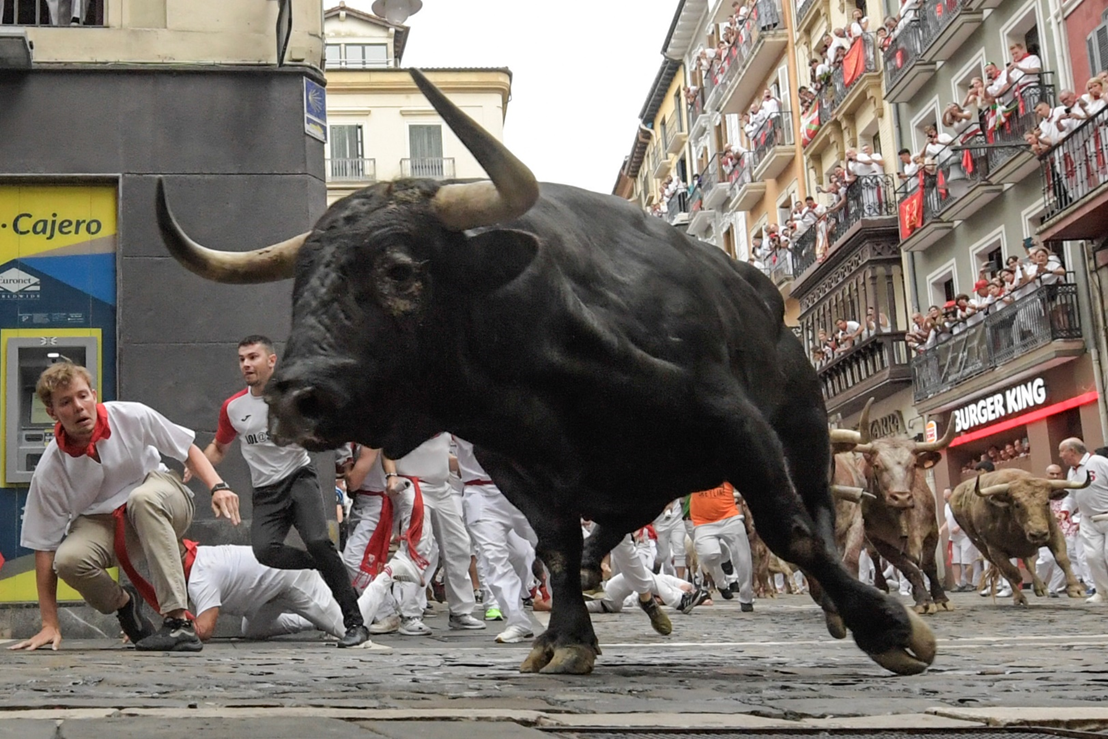
This is the ‘encierro,’ the world-famous running of the bulls.
Saint Fermin is the patron of the town of Pamplona, and the week of celebrations in his honour involves a series of bullfights.
Some centuries ago (no one knows when), someone had the bright idea of releasing the bulls into the street and allowing the public to run alongside them.
Over the years, the whole thing has been refined somewhat.
Today, the course is meticulously planned, side streets are sealed off, and protective fencing lines the route through the town centre.
The six bulls who will fight in the corrida later in the day are released into the special corral.
READ MORE: The quiet corner of Andalucia where the last of Spain’s nomad shepherds still roam
They wait nervously with the six steers who will accompany them.
Steers are castrated bulls. Though they are useless for fighting (steers are harmless and mild-mannered), they help enormously in making the ‘toros de lidia’ (fighting bulls) move.
Bulls are herd animals, and will refuse to run through the streets unless they feel the ‘safety’ of the steers around them.
The 900-yard ‘course’ through the old town is ready. Thousands of revellers are waiting to roar the runners on.
The human participants, a couple of hundred volunteers – known, of course, as ‘Sanfermines’ – are praying.
Yes, praying. It’s traditional. Before a statue of the saint, they recite the ancient prayer, and sing the song ‘Pobre de mi’.
A self-respecting runner will wear the time-honoured San Fermin outfit – all white, with red accessories.
The accessories should include the Basque beret (known as a ‘boina’), a neckerchief and a sash, worn around the waist.
When the rocket goes up at eight sharp, it’s game on.
From where they are in the Old Town, the runners can’t see the corral. The rocket is a signal to them, to inform them that the gate is open, and the animals are loose.
A matter of seconds later, a second rocket is fired to confirm that all six bulls are out and running.
Humans and bulls will career along the course to the plaza de toros. It ends when all six fighting bulls are safely inside the bullring.
The idea, for the human runners, is to get as close to the running bulls as they dare.
Any participant who keeps a safe distance is likely to incur the heavy verbal abuse of the onlookers, who are drinking alcohol (and have probably been at it all night).
Similarly, you don’t want to be the first runner to enter the bullring, because extreme derision awaits anyone who gets there ahead of the bulls.
Is it dangerous? Most decidedly, yes.
Roughly three hundred people are injured every day, and 15 have been killed by the bulls in the last 100 years.
Until 1923, no-one outside Spain (and only a handful of Spaniards) had ever heard of this medieval festival in this small northern town.
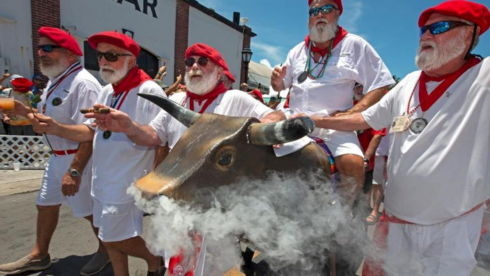
That’s when Ernest Hemingway happened along.
A citizen of the United States, Hemingway had driven an ambulance during the First World War.
Badly injured in 1918, he stayed on in Europe when the War ended. He became part of the ‘Lost Generation’, a group of Americans who could no longer believe in the old values of work, family and religion.
Hemingway discovered the San Fermin encierro and was delighted – the macho idea of risk appealed to him, and the closeness of death seemed to excite him (today, he might have been diagnosed with PTSD or something similar).
His novels (specifically The Sun Also Rises) introduce readers to the thrill of San Fermin and to the Spanish notion of men confronting fierce animals.
On and off, for almost forty years, Hemingway would maintain his love affair with Spain.
The date of his suicide – 2 July, 1961 – is doubly significant. It was the anniversary of the mortar explosion on the Italian Front which changed his life: and on that very day, in Pamplona, the bulls were running.
Click here to read more La Cultura News from The Olive Press.