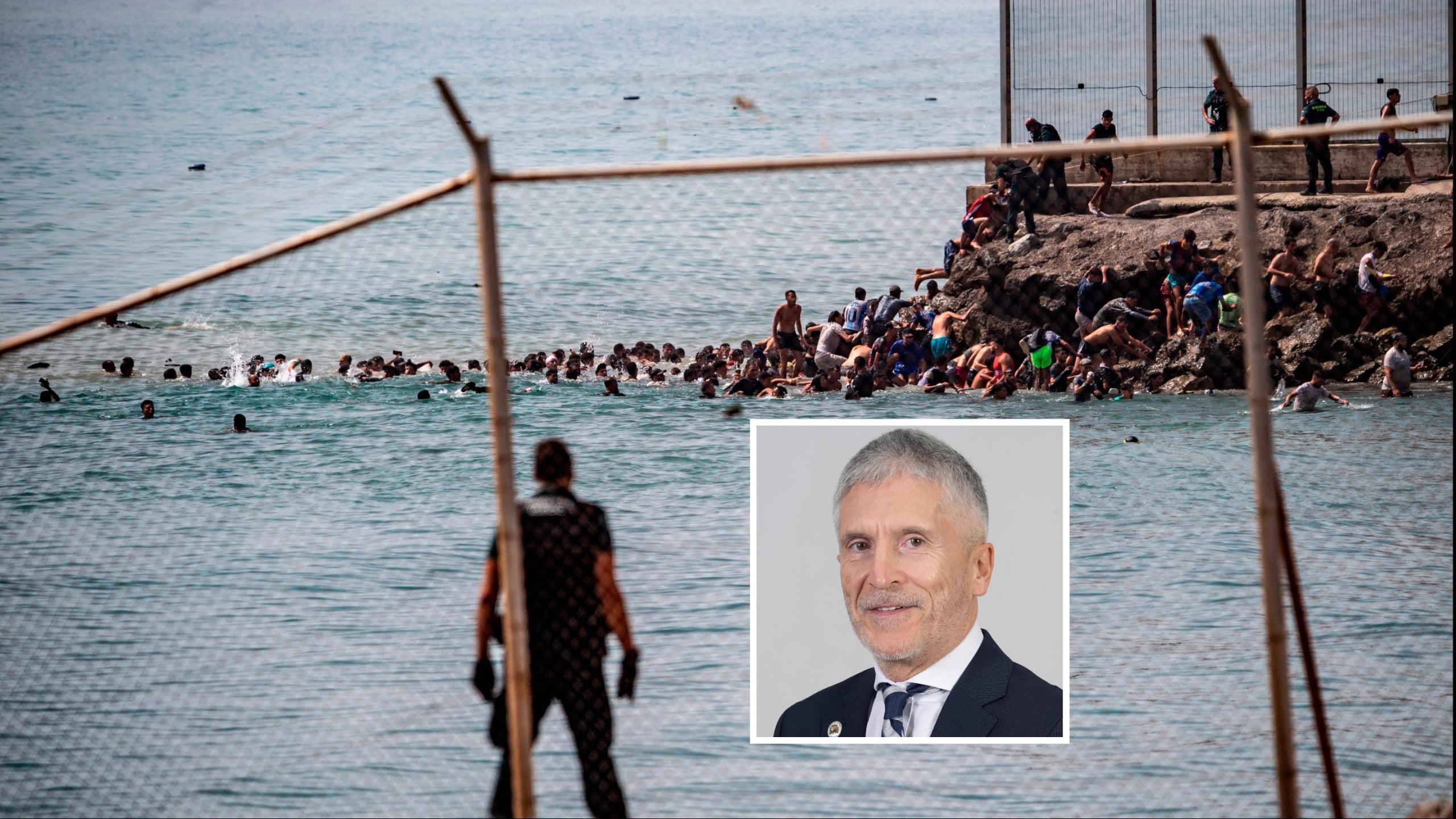
SPAIN has privately asked fellow EU governments not to blame Morocco publicly for the Ceuta crisis as the fallout continues in the international sphere.
At an online meeting of EU interior ministers on Tuesday, Madrid asked its European partners to avoid publicly criticising Morocco, according to Brussels-based outlet Euractiv, which cited three unnamed sources briefed on the talks.
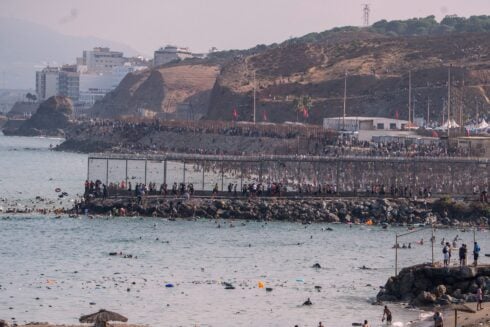
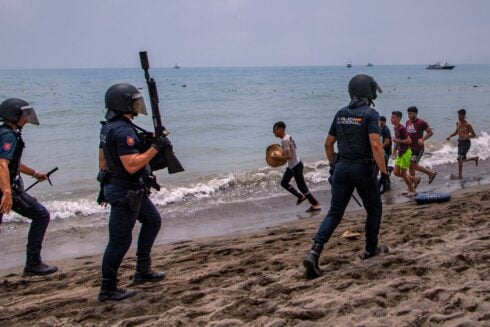
Many ministers on the call pressed Spain on how 72,000 people could have crossed from Morocco into Ceuta in a matter of days, with 70,000 having already left the enclave.
Asked directly at a press conference who was to blame, Interior Minister Fernando Grande-Marlaska said there did not need to be one at all.
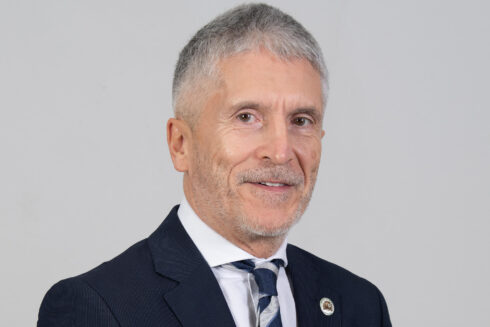
“There doesn’t necessarily have to be anyone to blame,” he said.
That line has not gone unchallenged inside Sanchez’s own government.
Defence Minister Margarita Robles broke ranks a day earlier, saying whoever had ‘consented to or tolerated’ the crossing ‘will have to take responsibility.’
“We cannot look the other way, neither Spain nor Morocco, in the face of this human drama,” she said — a marked departure from Grande-Marlaska and foreign minister Jose Manuel Albares, who have both called Morocco ‘a loyal partner.’
A Western government source told Euractiv that Morocco is believed to have at least tacitly approved the surge, seeing it as a political warning to Madrid.
That mirrors Spain’s own intelligence assessment, reported by The Olive Press earlier this week, that Rabat did not orchestrate the crossing but deliberately stood back and let it happen.
READ MORE: Trump turns Ceuta migrant crisis into campaign rallying cry ahead of crucial November midterms
Germany’s Friedrich Merz was the only major EU leader to publicly demand Morocco act, telling Rabat to take the migrants back immediately.
European Commission president Ursula von der Leyen avoided naming Morocco altogether, instead repeating that migrants should not be used to pressure the EU, and floated offering Rabat more financial support as Brussels looks at deepening ties with the kingdom.
Instead of confronting Morocco directly, the EU’s public response has shifted towards disinformation.
Migration commissioner Magnus Brunner said Europol was examining whether disinformation played a role in the crisis, while the EU’s diplomatic service, the EEAS, is looking into whether Russian-linked accounts sought to exploit the chaos online.
Frontex, the EU’s border agency, is seeking new powers to monitor disinformation on social media as part of an upcoming review.
That is exactly the kind of network we identified this week.
An intelligence report from Golden Owl, an Alicante-based OSINT firm, found close to half a million social media accounts had organised last week’s crossing, and warned that a Facebook group with 108,000 members was still calling for a repeat crossing on August 15.
Euractiv reported that no independent investigation had confirmed a coordinated disinformation campaign existed before the crossing took place.
However, Golden Owl’s report doing exactly that had already been public for a day.
While Brussels looks for someone else to blame, Spain’s own courts are asking the question directly.
Spain’s Audiencia Nacional, the national court that handles the country’s most serious crimes including offences against the state, has ordered the Guardia Civil to reveal whether it held any information in the days before the crossing that could have warned it was coming.
The order comes from Maria Tardon, the investigating judge at Central Instruction Court No. 3 in Madrid.
She has also asked for details of the rescue operations carried out on July 30 and 31, the two most critical days of the crisis, including the cause and date of death for those recovered from the sea and identity details for survivors.
Spain’s confirmed death toll from the crossing stands at 141, after bodies were recovered on both the Spanish and Moroccan sides of the border.
Judge Tardon’s investigation stems from a criminal complaint filed by Iustitia Europa, a political party that has separately joined the prosecutions against Pedro Sanchez’s brother and his wife, Begoña Gomez, as a private accuser.
Spanish law allows parties and organisations to bring criminal charges alongside the public prosecutor in this way, and the complaint alleges crimes against state security, facilitating illegal immigration and trafficking, criminal organisation, and a failure by officials to pursue crimes they should have prosecuted.
Tardon opened the case on Tuesday by asking the Policia Nacional for a report assessing whether the crossing was a ‘concerted or directed action’ by a criminal group, a step towards establishing whether the Audiencia Nacional even has the authority to hear it.
The gap between Spain’s public line and what its own agencies knew is disputed too.
Spanish broadcaster Cadena SER has reported that the CNI, Spain’s intelligence service, warned the interior ministry on several occasions before the crossing that a mass entry was likely, though not the exact date it would happen, and that the warnings were ignored because Ceuta’s border was under-resourced.
The interior ministry has dismissed this as ‘flatly false.’
Judge Tardon has not set a deadline for the Guardia Civil to respond.
Click here to read more Spain News from The Olive Press.