

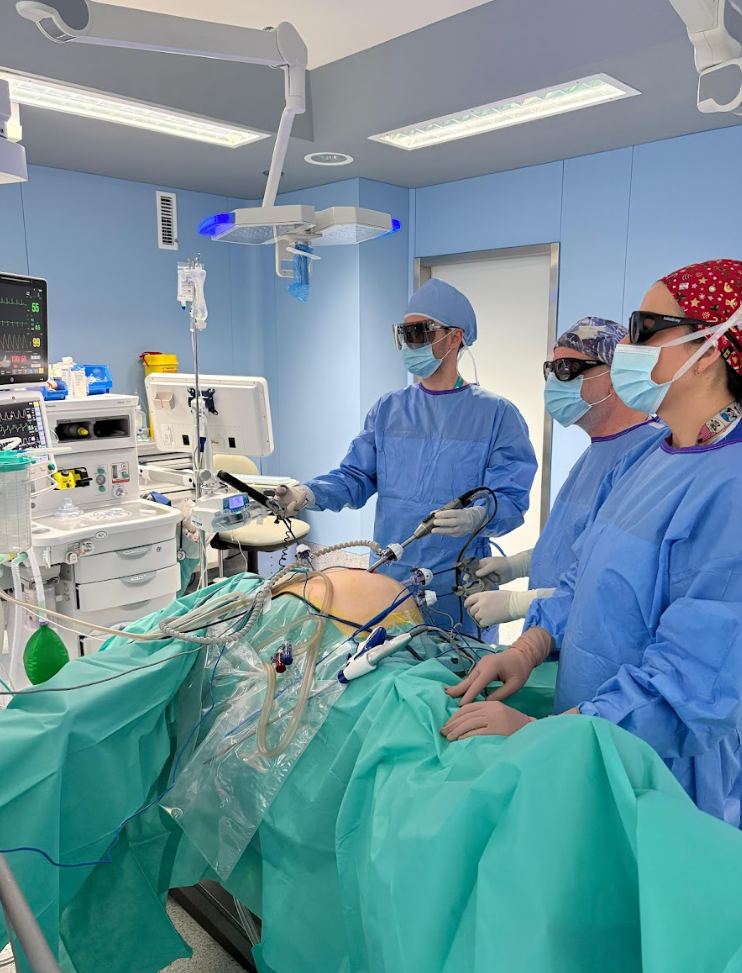
THREE-dimensional laparoscopic surgery is a type of procedure widely used in surgery for digestive tumours, but it also facilitates the learning process for young surgeons due to the improved visibility of organs and anatomical details.
When faced with the need for surgery, especially complex procedures, fears and uncertainty often arise.
Knowing the surgeon’s skill and experience provides peace of mind and security, while having all available technological tools at their disposal reduces the risk factor and increases the chances of success in achieving the surgery’s objectives.
3D laparoscopic surgery has represented a decisive advance in the way complex surgeries are performed.
In these procedures, the surgical team uses special glasses for three-dimensional vision.
READ MORE: Masks become compulsory in Malaga hospital as infectious diseases continue to spread
The instruments used are the same as in conventional laparoscopy, but the advantages offered by this technology are numerous and significant, both for patients and healthcare professionals.
Enrique Aycart, head of the General and Digestive Surgery Department at Quirónsalud Campo de Gibraltar Hospital and Quirónsalud Marbella Hospital, points out that the benefits for patients of this innovative technique include “greater accuracy and control when performing complex maneuvers, as it increases the precision of the surgeon’s surgical instrument movements; a better perception of the surgical field, as it offers a much more realistic image, accurately reproducing the depth between different organs; and a reduction in surgical time, especially when performing laparoscopic sutures, anastomoses, and complex surgeries.”
Furthermore, Dr. Aycart mentions the reduction in visual fatigue for the surgeon during longer operations, as well as the possibility of complications, by offering ‘better anatomical identification.’
READ MORE: REVEALED: The ‘instant’ hair miracle taking the Costa del Sol by storm – and no surgery required
In this regard, he emphasizes that 3D laparoscopic surgery “also accelerates the learning curve for young surgeons compared to conventional two-dimensional laparoscopy.”
This technology is generally indicated for “all surgeries that are expected to be more complex,” but particularly, Dr. Aycart explains, “for digestive cancer surgeries,” since “with better visibility and depth of field, more complex dissections can be performed with greater accuracy than in conventional laparoscopy.”
Furthermore, the specialist notes that “in this type of cancer surgery, it is very important to see the relationship of the tumors to the other organs in the abdomen, and it facilitates a more complex lymphadenectomy (removal of the lymph nodes in the area of the tumor), which helps us with tumor staging.
This is important both for the microscopic study of these tumors and for making decisions regarding adjuvant treatments such as chemotherapy or immunotherapy.”
READ MORE: Quirónsalud Marbella: A Pioneer in Private Healthcare in Andalusia with the Introduction of PTeye for Thyroid and Parathyroid Surgery
Dr. Aycart points out that the Quirónsalud Campo de Gibraltar Hospital and the Quirónsalud Marbella Hospital were pioneers in the use of 3D laparoscopy in their areas of influence, and that “we are using 3D laparoscopy more and more frequently and on more patients.
We have already operated on more than 100 patients with this technique and have obtained very satisfactory results.”
The Quirónsalud Hospital Group currently has eight hospitals in Andalusia located in the cities of Malaga, Marbella, Los Barrios (Cadiz), three in Seville (Sagrado Corazón, Infanta Luisa, Materno-Infantil), Cordoba and Huelva, in addition to 18 medical specialty and diagnostic centers and two surgical day hospitals in Seville and Malaga, which position it as the leading private hospital in this autonomous community.
READ MORE: Undergoing surgery in Spain’s Marbella for a complex condition and being discharged the same day is possible
Quirónsalud is the leading healthcare group in Spain and, together with its parent company Fresenius-Helios, also in Europe.
In addition to its operations in Spain, Quirónsalud also has a presence in Latin America.
Together, they employ more than 50,000 professionals across more than 180 healthcare centers, including 57 hospitals with over 8,000 beds.
They boast state-of-the-art technology and a large team of highly specialized and internationally renowned professionals.
READ MORE: How doctors in Spain are freezing tumours at -40ºC to rid patients of cancer while avoiding surgery
Their centers include the Fundación Jiménez Díaz University Hospital, Teknon Medical Center, Ruber Internacional, Quirónsalud Madrid University Hospital, Quirónsalud Barcelona Hospital, Dexeus University Hospital, Gipuzkoa Polyclinic, General de Catalunya University Hospital, Quirónsalud Sagrado Corazón Hospital, and others.
The Group is committed to promoting teaching (eleven of its hospitals are university hospitals) and medical-scientific research (it has the FJD Health Research Institute, accredited by the Ministry of Science and Innovation).
Furthermore, its healthcare service is organized into cross-functional units and networks that optimize the accumulated experience across its various centers and facilitate the clinical application of its research.
READ MORE: SPORTING SUCCESS: The Knee, Hand and Shoulder Unit of the Orthopedic Surgery and Traumatology Service of Hospital Quirónsalud Marbella deals with many golf, tennis/padel and watersports injuries
Quirónsalud is currently developing numerous research projects throughout Spain, and many of its centers are at the forefront of this field, pioneering work in various specialties such as oncology, cardiology, endocrinology, gynecology, and neurology, among others.
Click here to read more Andalucia News from The Olive Press.