

SPAIN could face a wave of evictions numbering in the thousands after parliament once again rejected the extension of a key housing protection introduced during the pandemic.
The moratorium was designed to protect vulnerable families from being kicked out of their homes during Covid if they found themselves unable to pay the rent or meet their mortgage.
The measure allowed judges to temporarily pause eviction proceedings while social services attempted to find housing solutions for vulnerable tenants.
In March of 2020, Pedro Sanchez admitted, “Not only will the moratorium be extended to avoid evictions due to unpaid mortgages, but its remit will also be extended so that the decree includes more cases of vulnerability in many families.”
READ MORE: Narco shootout leads to discovery of cocaine bunker holding a tonne of drugs buried in woods near Marbella

Pablo Iglesias, the founder of left-wing Podemos party, added: “The government is also going to stop some evictions for non-payment of rent in high-tension markets where there are vulture funds involved.”
But lawmakers in the Congress of Deputies voted this week against extending eviction moratorium.
The People’s Party (PP), Vox and Junts per Catalunya voted in opposition to the decree say it risked encouraging illegal occupation of properties, a politically sensitive issue in Spain.
Miriam Nogueras of Junts per Catalunya defended her party’s decision in rejecting the decree: ‘Social safety net, yes; squatting, no.’
However, critics argue that the measures could now make it harder for property owners to recover their homes if occupied by squatters.
READ MORE: Spain’s Foreign Minister rubbishes White House comments that it is ‘cooperating’ with U.S. over war in Iran

A recent report estimates that four out of ten renters in Spain are at risk of poverty, social exclusion, or both.
Housing activists warn that the decision could leave 60,000 to 70,000 vulnerable households at risk of eviction in the coming months.
Campaigners say its removal threatens to worsen what experts describe as a deepening housing emergency across Spain.
Outside parliament in recent weeks, activists from the anti-eviction groups protested, warning of a landslide of evictions if protections were allowed to lapse.
READ MORE: Narco shootout leads to discovery of cocaine bunker holding a tonne of drugs buried in woods near Marbella

‘The message from Congress is clear: housing is a business, not a right,’ argued the Tenants’ Union.
Another present issue is the increase of ‘invisible evictions,’ when a tenant is forced out of their property before any legal proceedings, like an eviction has occurred.
Alejandra Jacinto, a lawyer from CAES who has handled dozens of eviction cases, said the decision leaves vulnerable families exposed.
READ MORE: ‘Wonderful, very sensitive girl with a huge heart – we will get justice’: The heartbreaking letter from parents of ‘bullied’ girl, 14, who took her own life on the Costa del Sol
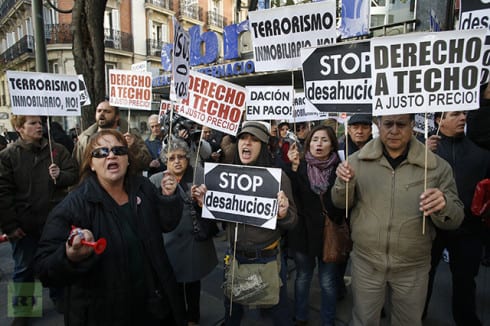
‘This is unacceptable in a democratic state governed by the rule of law, that suddenly there will be no protection or safeguards when sending people in vulnerable situations out onto the street,’ she said.
Around half a million rental contracts that were signed during the pandemic are said to be ending this year, ‘leaving many people unprotected against eviction attempts.’
Data compiled by the European Anti-Poverty Network Spain shows the moratorium and related protections helped prevent around 1.5 million people from falling into poverty during recent years.
READ MORE: OPINION: Spain’s Muslim community is more right-wing than you think – and has little tolerance for squatters or high taxes
For tenants facing rent increases or eviction notices, the end of the moratorium removes one of the few legal tools that could delay or halt proceedings while authorities search for alternative accommodation.
Financial hardship in Spain is largely due to rising rental costs. Nearly 18% of tenants struggle to afford basic necessities.
Figures released by the General Council of the Judiciary show that 27,564 evictions were carried out in 2024, an increase of 3.4% compared with the previous year.
READ MORE: South Madrid residents at their wits’ end after squatters’ apartment fire caps months of disturbances
Catalonia accounted for the largest share of evictions, with 26% of all cases nationwide at 5,539 linked to rental disputes.
Andalucia followed with 4,027 evictions, while Valencia recorded 3,610 and Madrid 2,375.
Housing advocates warn that with the moratorium no longer in force, eviction proceedings that had previously been paused could now resume in courts across the country.
Click here to read more Property News from The Olive Press.