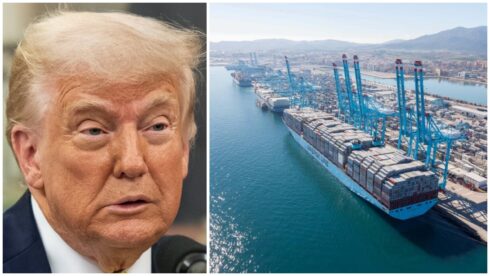


TRAFFIC through the Iran-controlled Strait of Hormuz, a vital maritime route for global trade, has ground to a near-total standstill as Tehran retaliates for US-Israeli bombings.
The number of ships passing through Hormuz has plummeted by more than 95% since Iran’s blockade on Sunday, with marine tracking websites showing only two vessels transiting the strait in the past 48 hours. By comparison, more than 100 ships passed through Hormuz on Friday last week alone.
Hundreds of vessels are now clogging both sides of the waterway as key oil exporters – including the UAE, Qatar, Bahrain, and Kuwait – wait for transit to resume.
Nearly one fifth of the world’s oil is regularly shipped through the Strait of Hormuz, according to the International Energy Agency, and the clampdown has already sent global fuel prices skyrocketing.
The price per barrel of Brent crude oil, the benchmark reference for Europe and much of the world, has already risen 7% this week alone – the steepest surge in nine months.
In Spain, petrol averaged €1.486 per litre on Monday, according to the EU’s Weekly Oil Bulletin, with diesel trailing at €1.441 – the highest prices since December.
The figures, which represent a 1% jump compared with last week, mark the sharpest increase since June – and are likely to climb further if traffic through Hormuz does not resume soon, experts warn.
Elsewhere in Europe, the war sent power prices swinging wildly this week, though Spain was one of the few EU nations to keep volatility low.
In the Netherlands, prices soared from €24 per megawatt-hour (MWh) to almost €450 in under four hours, while in Denmark they jumped from €26 per MWh to €430.
Similar trends were seen in Belgium and Germany, the Financial Times reported, but Spain was spared the brunt of the hikes, with prices staying well below the €200 mark.
The Hormuz closure is wreaking havoc beyond Europe as well, with South-East Asia bearing the brunt. In 2025, China received 25% of all oil from Middle Eastern producers, according to Bloomberg – with India, Japan, and South Korea close behind.
Most of the oil imported by the EU, by contrast, does not come through the Strait of Hormuz, but from neighbouring Norway and the United States, which together accounted for nearly a third of all the oil purchased by EU nations in 2025, according to Eurostat.
Saudi Arabia and Iraq, however, account for 14.5% of the oil imported by the EU, with Greece and France set to feel the sting of the clampdown.
Spain appears less vulnerable to the disruption, importing oil only from Iraq – which is not among its five main suppliers.
Madrid, however, does import liquefied natural gas (LNG) from Qatar, which announced on Wednesday that it had halted all production following strikes from Iran.
The country’s energy minister, Saad al-Kaabi, said the war could eventually ‘bring down the economies of the world’ as Asian buyers outbid Europeans for whatever gas was available on the market.
Qatar’s stark warning compounds a looming threat from the US to stop all trade with Spain following its refusal to allow American forces to use jointly-operated bases for strikes on Iran.
In 2025, Spain imported about 45% of its LNG from the US, according to the Bank of Spain, and would likely face critical energy shortages if Trump were to follow through on his threats.
The combined effects of rising petrol prices and a potential US trade embargo could ripple through household bills and domestic manufacturing in Spain, experts warn, hampering the country’s economy.
Placing further strain on global supply chains was Zimbabwe’s announcement last week that it would indefinitely ban exports of critical raw materials and lithium concentrates worldwide.
Lithium is widely used to manufacture batteries, and Zimbabwe is Africa’s top producer – with most of its lithium exported to China for processing into high-grade battery materials, which are then distributed across the world.
The ban came amid government allegations of malpractice and leakages in the industry, Zimbabwe’s mines ministry has said, and it is currently not known how long it will remain in force.
Iran has followed through on a threat to halt all traffic through the Strait of Hormuz in retaliation for the US-Israeli onslaught on February 28, which killed the country’s Supreme Leader, Ayatollah Khamenei, and triggered an unprecedented military escalation across the Middle East.
Tehran has deployed signal jammers near the strait, making it difficult to transit and monitor traffic, and has also opened fire on at least three US vessels since Sunday, according to the Iranian Ministry of Defence.
Iran’s president, Masoud Pezeshkian, claimed on Friday morning that ‘mediation efforts’ to end the war had begun.
But Trump said shortly afterwards there would be no deal with Iran ‘except unconditional surrender,’ adding this would be followed by the ‘selection of a great and acceptable leader.’
Click here to read more International Affairs News from The Olive Press.