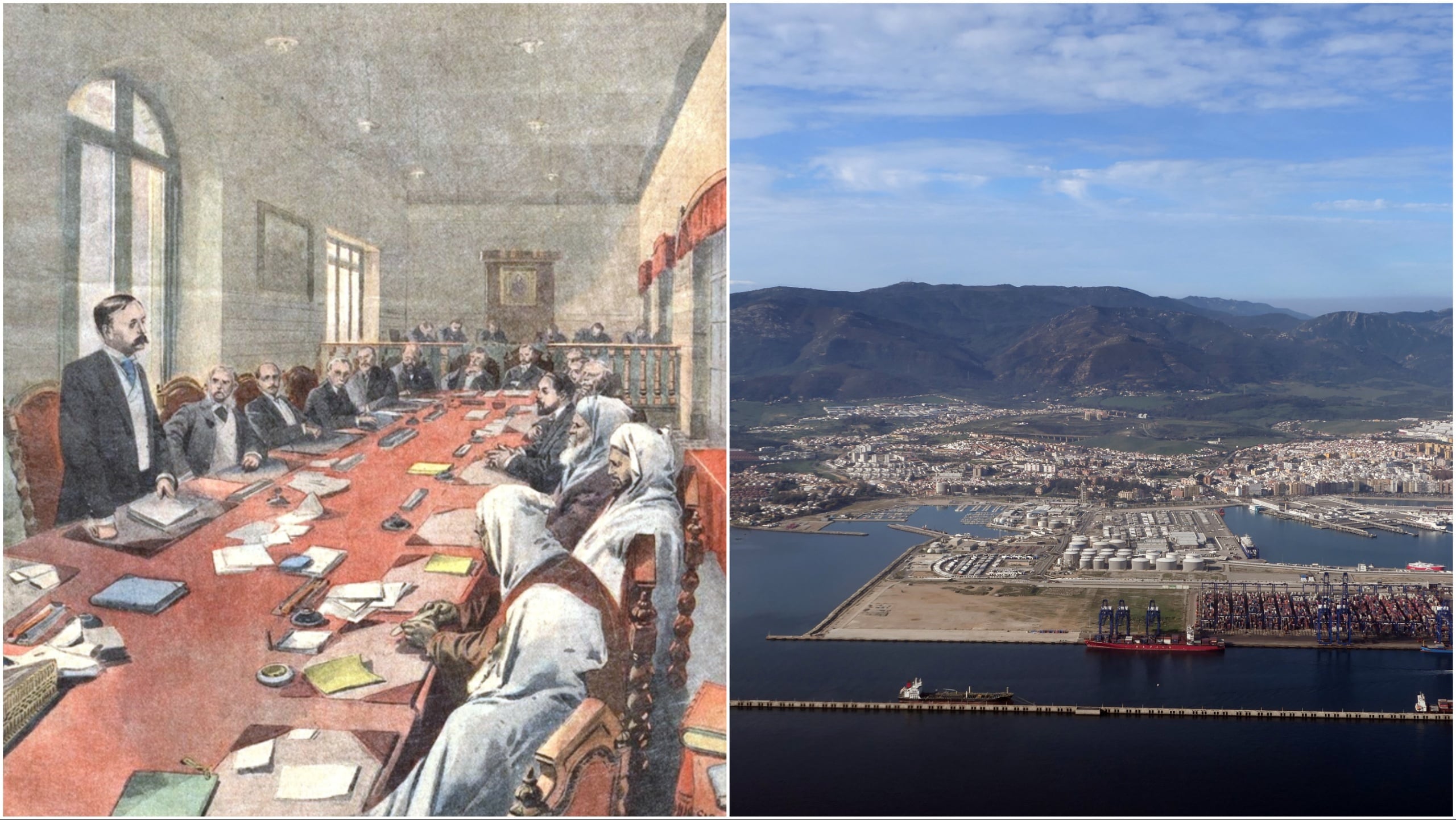
ON 7 April, 1906, an international conference ended in Algeciras, just across the bay from Gibraltar.
Some historians say that the conference was, itself, one of the causes of the First World War.
What happened in Algeciras has to be seen against the background of the ‘scramble for Africa’, and the ‘Entente Cordiale’.
We tend to think that Germany has always been a player on the international scene, but in fact the German nation came into being as recently as 1871.

Germany’s problem, as the new kid on the block, was colonies.
The way to make money in the 1800s was to conquer somewhere engulfed in poverty like Sudan or Tahiti.
Underdeveloped countries were easy to beat – they didn’t have modern weapons – and they had lots of untouched resources.
European countries could grab these resources (timber from Cuba, cotton from India), bring them home, make them into things, then force the colony to buy them back.
Britain and France got very rich doing this, and Germany wanted to join the club, but by the tail-end of the 19th century, most of the available colonies had been snapped up.
In 1890, the German Emperor – Kaiser Wilhelm – sacked his Chancellor, Count Bismarck.
Probably the only person in Europe who couldn’t see how foolish this was, was the Kaiser himself.
Bismarck had been ‘running’ Europe with skill and wisdom for 30 years, but the Kaiser wanted Germany to be more aggressive.
This pushed Britain and France (who had been mutually hostile over Africa) into each other’s arms.
In 1904 Britain and France signed a Treaty of Friendship called the ‘Entente Cordiale’.

They agreed to help each other in the event of a war against Germany.
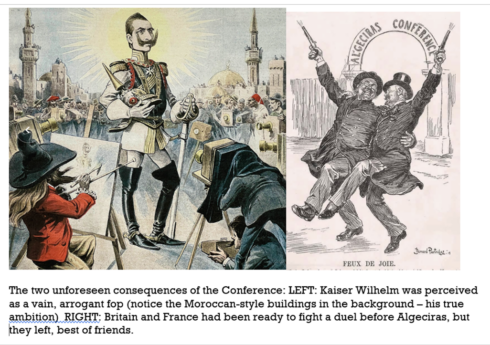
A year later, the Kaiser thought he’d found a trick to strengthen Germany’s position, and to drive a wedge between Britain and France.
He was on a cruise along the North African coast.
He stopped off at Tangier, and made a speech calling for Morocco’s independence.
He supposed he was acting as the champion of small nations, but he seriously angered France and Spain, both of whom were trying to carve out an empire in the region.
The Conference was called for the start of 1906 and its aim was to take the sting out of the international situation.
It has to be seen as a failure.
Apart from setting up Moroccan port police and arranging some loans for the Sultan, it avoided the big issue – imperialism.
Attention switched to Eastern Europe.
The Ottoman Empire (what we now know as Turkey and the Middle East) was in terminal decline.
Russia and Austria were looking for a chance to attack it.
The German Kaiser recruited Austria and Turkey as allies. This drove Russia to make friends with Britain and France.
The scene was set for World War One – the Entente Powers (Britain, France, Russia) against the Central Powers (Germany, Austria, Turkey).
Like mountaineers, roped together, they thought they were making themselves safe, but these alliances would in fact drag them all into the abyss.
But war was still a few years away.
The Kaiser caused a second Moroccan crisis in 1911, when he sent a German warship to the port of Agadir.
He was protesting about French military operations in the Moroccan interior, and he gave France two choices: go to war with Germany, or hand over half of Morocco.
Lloyd George, in London, warned the Kaiser that Britain would honour its commitment to France if hostilities broke out. Germany had to back down.
But by this stage there was no way out. The cataclysm which would destroy four great empires was unavoidable.
Curiously, it was Britain’s insistence on honouring her commitments that finally started the fighting.
When Belgium was set up as a new nation after the Napoleonic Wars, Britain promised the fledgling country to protect it.
In 1914, the Kaiser’s armies chose to enter France through Belgium, thus avoiding the elaborate French defences.
So Britain dusted-off the hundred-year-old Treaty, and went to war with Germany.
The irony is, the original promise was intended to protect Belgium … against France!
Click here to read more Spain News from The Olive Press.