

SANDWICHED between the Bay of Biscay and the French border in the Basque Country’s northeasternmost corner, the province of Gipuzkoa may not appear familiar to the average English football fan.
With a total area of just 760 square miles Gipuzkoa is the smallest of Spain’s 50 provinces, but in the world of English football this tiny community punches well above its weight.
Mikel Arteta, Arsenal manager, Andoni Iraola, AFC Bournemouth manager, and Unai Emery, Aston Villa manager are not just linked by the first letter of their respective clubs – they all hail from this tiny, football-mad corner of Spain’s richest region.
And all three have had reason to celebrate this week.
On Tuesday, Iraola’s side drew 1-1 with Manchester City to hand the Cherries a first shot at European competition in the south coast club’s history.
Things could get even better on Sunday if results fall their way, with the scarcely-believable possibility of qualifying for the Champions League.
READ MORE: Spanish football legend Sergio Ramos agrees €450m deal to buy boyhood club Sevilla
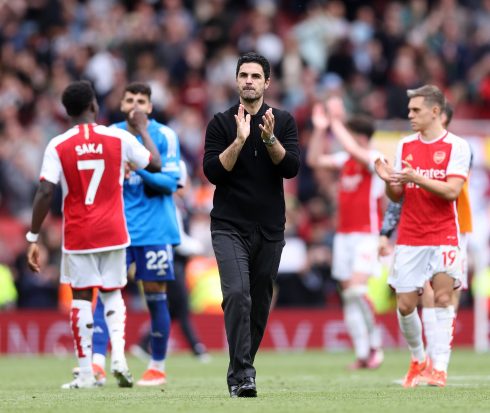
Tuesday night’s result also had permutations for compatriot Arteta, with a draw handing his Arsenal side a first Premier League title in more than two decades.
The next day, Emery led Villa to Europa League glory with a 3-0 win over Freiburg in Istanbul – marking the Birmingham-based side’s first trophy in over 30 years.

Remarkably, Arteta and Iraola even played in the same team as promising youngsters, alongside Xabi Alonso, named as the new Chelsea boss earlier this month.
The trio, all good friends, played together in the light blue of Antiguoko, an amateur youth side in San Sebastian known for producing some of Spain’s most prestigious footballing talents, before Arteta left to join Barcelona’s La Masia academy at the age of 15.

So how has this little province, host to just 750,000 people or 2% of Spain’s population, emerged as a key player in English football?
Although the Basque Country is not the only region of Spain to have been introduced to football by the British, it is perhaps the area most proud of its historic roots.

Athletic Bilbao, based in the neighbouring province of Biscay and Spain’s fourth most successful club, came to be thanks to British workers and Basque students returning from studies in Britain.
In the late 19th century, Bilbao was a thriving industrial metropolis – thousands of British workers from port towns including Southampton and Sunderland migrated, bringing football with them, whilst students returned from the UK invested with excitement in the discovery of this new sport.
Soon after, the club was formed – Athletic’s traditional red and white stripes even reflected their British roots, originating from a shipment of shirts that arrived from Southampton mirroring the south coast club’s own kit colours, while the club even had an English manager, Howard Kendall, in the 1970s.

Within Spain, the Basque people are also regarded as grittier, tougher and rougher, reflected in their style of football.
Bilbao legend Andoni Goikoetxea was famously dubbed ‘The Butcher of Bilbao’ after breaking Diego Maradona’s ankle in a match in 1983, and many view Basques as more adept at adapting to the infamous physicality of English football.
Another reason might be demonstrated through the story of Gipuzkoa’s most famous son.
Juan Sebastian Elcano is best known for having completed the first circumnavigation of the Earth in his ship, Victoria, and many Basques see that daring sense of adventure and exploration as fundamental to the region’s psyche.

All of the aforementioned managers ventured beyond Gipuzkoa’s borders to learn from other experiences and cultures – Arteta plied his trade in Scotland and England, Iraola became obsessed with NFL and their coaching methodology after a spell in the MLS with New York City FC, while Emery went as far afield as Moscow as he honed his craft.
This means that Gipuzkoans are not just typically ruthless, demanding or hard-working, but also crucially adaptable.
An alternative explanation – albeit less romantic than stories of 15th century explorers – could lie in the province’s extensive financial resources.
The province’s capital of San Sebastian – known as Donostia to its inhabitants – has the highest income per head in all of Spain, with money pumped into youth sport.
Unlike other parts of Spain, training facilities and pitches are of a high-quality, giving young players the platform to develop and thrive into first-team players and, like Iraola, Emery, Arteta and co., highly successful coaches.
Click here to read more Spain News from The Olive Press.