

THE ancient almadraba fishing system has been netting giant bluefin tuna crossing the Straits of Gibraltar for over 3,000 years.
This month, as the world’s most valuable fish arrived in the Med from the mid-Atlantic, foodies in Marbella got an amazing chance to see one close up.
In a rare ‘ronqueo’, a giant 113-kilo bluefin was carved up at the leading restaurant, Koi.
Freshly-caught in Barbate, the fish was delivered by Pescado Morales y Godoy, rolled into the restaurant on a four-wheel cart.
And just like the way it was caught the day before, food lovers thrashed about to get the best position to film the extraordinary event.
Something completely out of the ordinary, the 100 or so diners got to see the traditional Spanish art of carving it up into its many prized parts.
READ MORE: Watch the ancient art of bluefin tuna carving at KOI Marbella – Followed by exclusive Omakase dinner
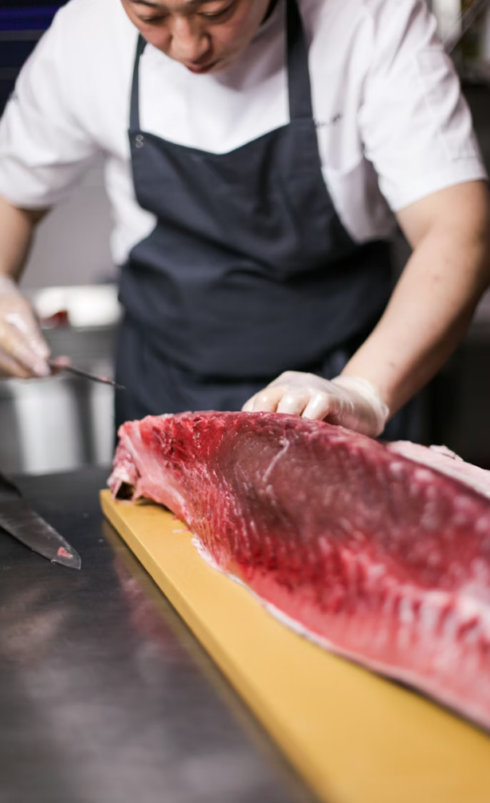
As the skillful team of butchers began to carve they drew their first applause.
Using a series of knives and cleavers, first the head was removed, before the prized ‘parpatana’, the neck, appeared bright red, rich and juicy.
By then, all conversations had stopped as guests watched the steady hands as they carved out nearly a dozen different cuts.
Next, it was up to Executive Chef Stan Rozbitsyy to bring the theatre of the cutting to the plate.
An amuse-bouche: Akami tuna tartare in delicate tartlets with avocado purée and Oscietra caviar. It was a small bite, but ‘explosive’ as Jon Clarke, our Editor-in-Chief put it.
Then came a Ceviche with smoked leche de tigre, seared avocado, sweet potato and pomegranate. It was fresh, smoky, sharp and elegant, carrying you from the costas to Peru.
We were soon back with a carpaccio with green shiso, edamame pesto and grated spring truffle. The toro was so buttery it almost disappeared on the tongue and had the taste of the sea, but none of the heaviness.
By the time the tuna mellow rice arrived, with porcini mushrooms, chilli and smoky grilled tuna, the evening had become more than a meal.
It was a reminder of why the almadraba method has survived for three millennia and why bluefin is the world’s most valuable fish.
Click here to read more Spain News from The Olive Press.