
 Kathryn Richardson (Reporter)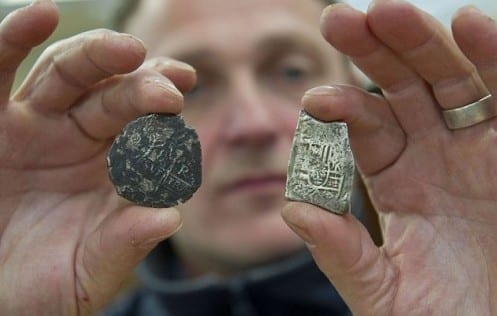
By Kathryn Richardson
RARE 300-year-old coins found in a British shipwreck off the coast of Gibraltar will be sold in England next week.
The pieces are believed to be the currency used by pirates and were recovered from the HMS Association which launched from Portsmouth in 1697.
The boat was also used in the Capture of Gibraltar in 1704.
The types of coin found were ‘pieces of eight’ and the Spanish ‘cob’.
The ‘pieces of eight’ is known as the world’s first global currency used across the Spanish Empire.
The unusually shaped Spanish ‘cob’ was used in the 17th century and was cut into shapes to be melted down to make jewellery.
Together the coins are valued at £50.
A Hanson Auctioneers & Valuers spokesman said: “The sole association of pieces of eight and pirates has grown, and now they are commonly used in films such as the Pirates of the Caribbean.”
Daniel Defoe refers to the coins in Robinson Crusoe when Crusoe sold a boy for 60 pieces of eight.
Robert Louis Stevenson also made them famous in his novel Treasure Island when Long John Silver’s parrot was trained to cry out ‘pieces of eight’.
The HMS Association sank in 1707 off the coast of Scilly on its return to England.
Its 800 crew died in the disaster.
Click here to read more News from The Olive Press.




The Association sank, along with other major ships, in 1707 on the rocks of Scilly Islands, Cornwall, UK and have little to do with Gibraltar other than its capture.
Pieces of eight are commonly recovered from shipwrecks of the 16th-17th centuries, sometimes in tens of thousands.