

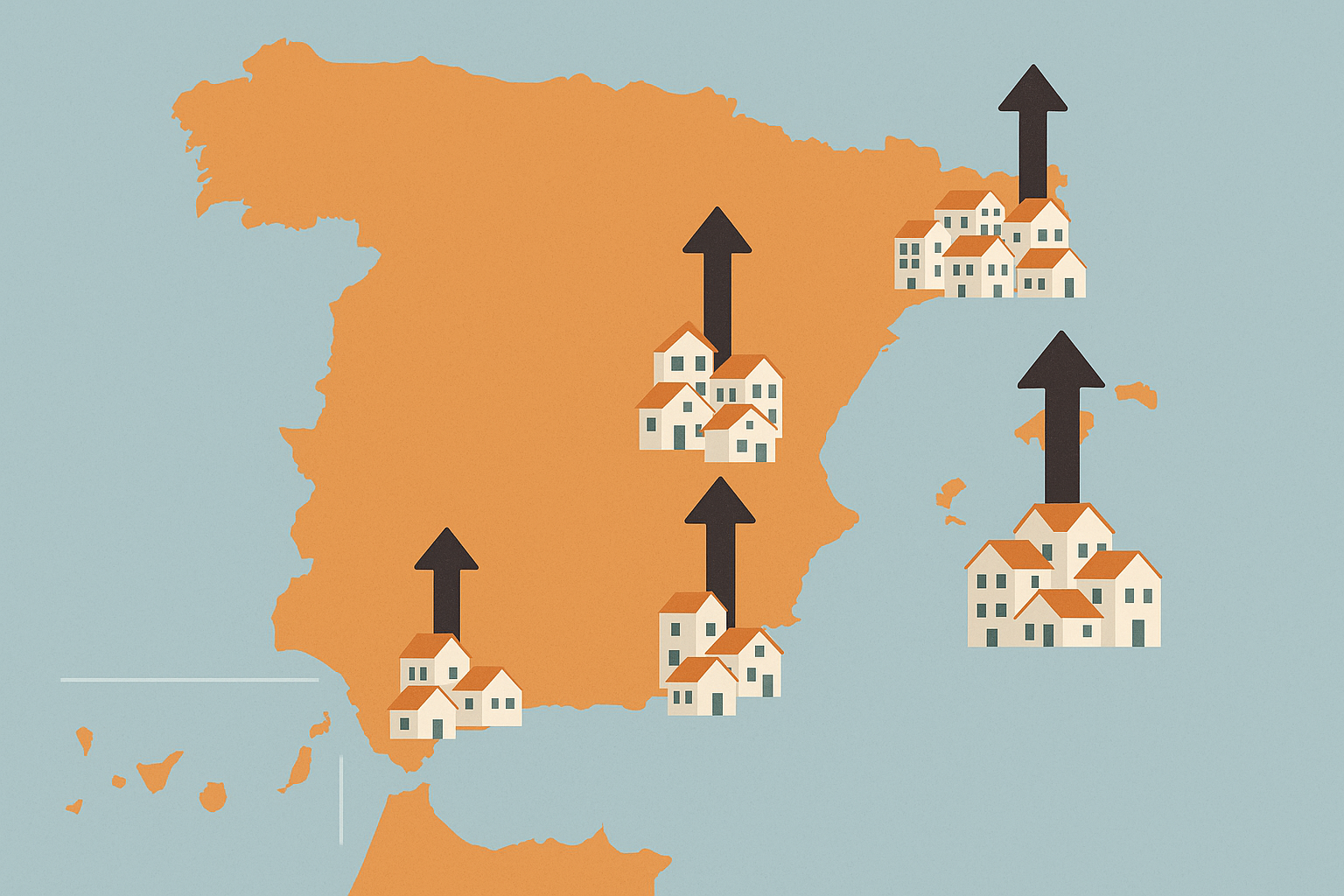
A NEW star has emerged as Spain’s biggest property hotspot after house prices in the region jumped a staggering 22.5% over the past year.
The surge makes Murcia the fastest-rising housing market in the entire country, according to new figures from Idealista.
The increase is even higher than in Madrid, where prices rose 21%, and far above Andalucia on 19.8% and the Valencian Community on 17.3%.
Nationally, prices rose 16.1% in the past year, their fastest pace in more than a decade.
Yet despite Murcia’s rapid growth, it still remains one of the cheaper parts of Spain to buy a home.
The average price in the region is still well below many coastal hotspots, meaning buyers can find properties for a fraction of what they would cost on the Costa del Sol, in the Balearics or near Madrid.
Idealista’s latest index shows non-new build homes across Spain have hit an all-time high of €2,605 per square metre.
READ MORE: Renting in Spain? It requires more income than buying a property, alarming study reveals
On the Costa del Sol this has soared to €4,024sqm – meaning an average two-bed flat could cost around €331,800 – and in Madrid it is an even higher €4,491.
Yet Murcia still remains one of the cheapest regions in Spain, with used homes averaging €1,665sqm, meaning a typical two-bed flat of 75–90sqm still costs only €125,000–€150,000 – even after a 22.5% annual increase.
It puts Murcia below other expat favourites on the Mediterranean.
Alicante now sits at €2,670sqm (around €200,000–€240,000 for a two-bed) after a 14.3% rise year-on-year.
Valencia province, meanwhile, is a more reasonable €1,926 sqm (roughly €145,000–€175,000 for a similar flat) despite a substantial 22.3% jump over the same period.
READ MORE: Looking to retire in Spain? This is the cheapest town in Malaga province to buy a property
By contrast, prices jump dramatically in Spain’s premium coastal markets.
Barcelona province stands at €3,084 sqm (two-beds around €230,000–€280,000); the Balearic Islands hit a record €5,114 sqm (often €380,000–€460,000); and even the Canary Islands reach €3,123 sqm (about €235,000–€280,000).
At the other end of the scale, some of Spain’s cheapest areas include Ciudad Real at €763 sqm, Jaen at €852 sqm and Cuenca at €867 sqm.
Murcia’s sharp increase may illustrate that it is no longer a secret gem, with demand growing from both Spanish buyers and foreigners looking for better value outside the traditional costas.
READ MORE: Brits and foreigners are still hoovering up property in Spain – here’s where they are buying
The region has seen rising interest from northern European buyers priced out of Alicante and Andalucia, as well as from remote workers seeking more space for less money.
Part of what is driving the surge in house prices is the huge investment in new high-speed rail links.
The €3.6 billion Murcia–Almeria line and the €600 million rebuild of Murcia’s El Carmen station ar set to transform the region’s connectivity over the next two years.
Idealista’s data, meanwhile, only reflects asking prices, not completed sales, but it is widely used as an indicator of market momentum.
The figures underline how quickly conditions are shifting in parts of Spain where property was once considered undervalued.
If the current trend continues, Murcia may not remain a bargain for long.
Click here to read more Property News from The Olive Press.






Map of Spain – the images needs titles – ‘Murcia’ etc. Never over-estimate your readers knowledge of geography.