
THE Balearic Islands and Murcia on the mainland are hurtling towards an ecological catastrophe, with a staggering 85% of the archipelago and an incredible 99.8% of Murcia facing desertification.
New findings from the CSIC (Spanish National Research Council), paint a terrifying picture: years of relentless human pressure, from farming and livestock to the massive tourism industry, are pushing the islands to the point of no return.
A new report, the first-ever Desertification Atlas of Spain, has unified the work of dozens of experts to reveal the shocking scale of the nation’s environmental crisis.
Spain has been over-exploiting its natural wealth for too long, and the consequences are now brutally clear. The Balearics are a major flashpoint, with huge tracts of once-vibrant land becoming increasingly barren.
- Nearly 40% of Spain’s entire territory is now caught in the grip of desertification.
- The crisis is widespread, but the Balearics are singled out as a critical hotspot with an alarming 85% of land deteriorating rapidly.
- The Region of Murcia leads the grim statistics, with a devastating 99.8% of its land now classified as arid.
The Atlas confirms that 43.35% of Spain is officially vulnerable to degradation. Even more concerning, 60.94% of the country’s existing dry zones are already showing unmistakable signs of desertification. This totals an immense 206,203 km².
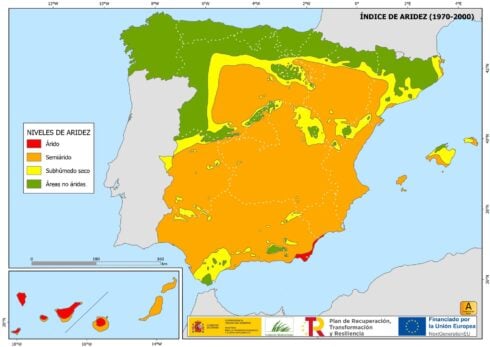
The devastation is clearly seen in areas like Alicante, where a chilling 98.9% of arid land is under threat. Valencia follows with 81.9%, and Castellon with 57.3%. Experts warn that Spain is rapidly losing its ability to sustain its historically fertile regions.
At the very core of this environmental nightmare is Spain’s profound water scarcity. Jaime Martínez Valderrama, a lead project scientist, highlighted a crucial fact: four out of five Spaniards now reside in arid zones. The attraction of the ‘mild climate’ is masking a growing resource conflict.
The scientific consensus is clear: we need urgent, multifaceted solutions, including vast improvements in wastewater recycling, greater reliance on desalination, and essential upgrades to water networks to halt catastrophic leakage.
The experts behind the Desertification Atlas hope their 66 detailed maps – covering everything from climate to biodiversity – will force political leaders to finally make sensible, long-term decisions about land and water management.
One major opportunity is better water recycling. Urban centres use 4,000 cubic hectometres of water annually, yet currently, only a mere 12% of this is being recycled for a second use.
The clock is ticking. The 85% desertification rate in the Balearics is an alarm bell.
With climate change accelerating the decay and over-exploitation causing irreversible damage, immediate action is no longer optional.
Click here to read more Environment News from The Olive Press.