

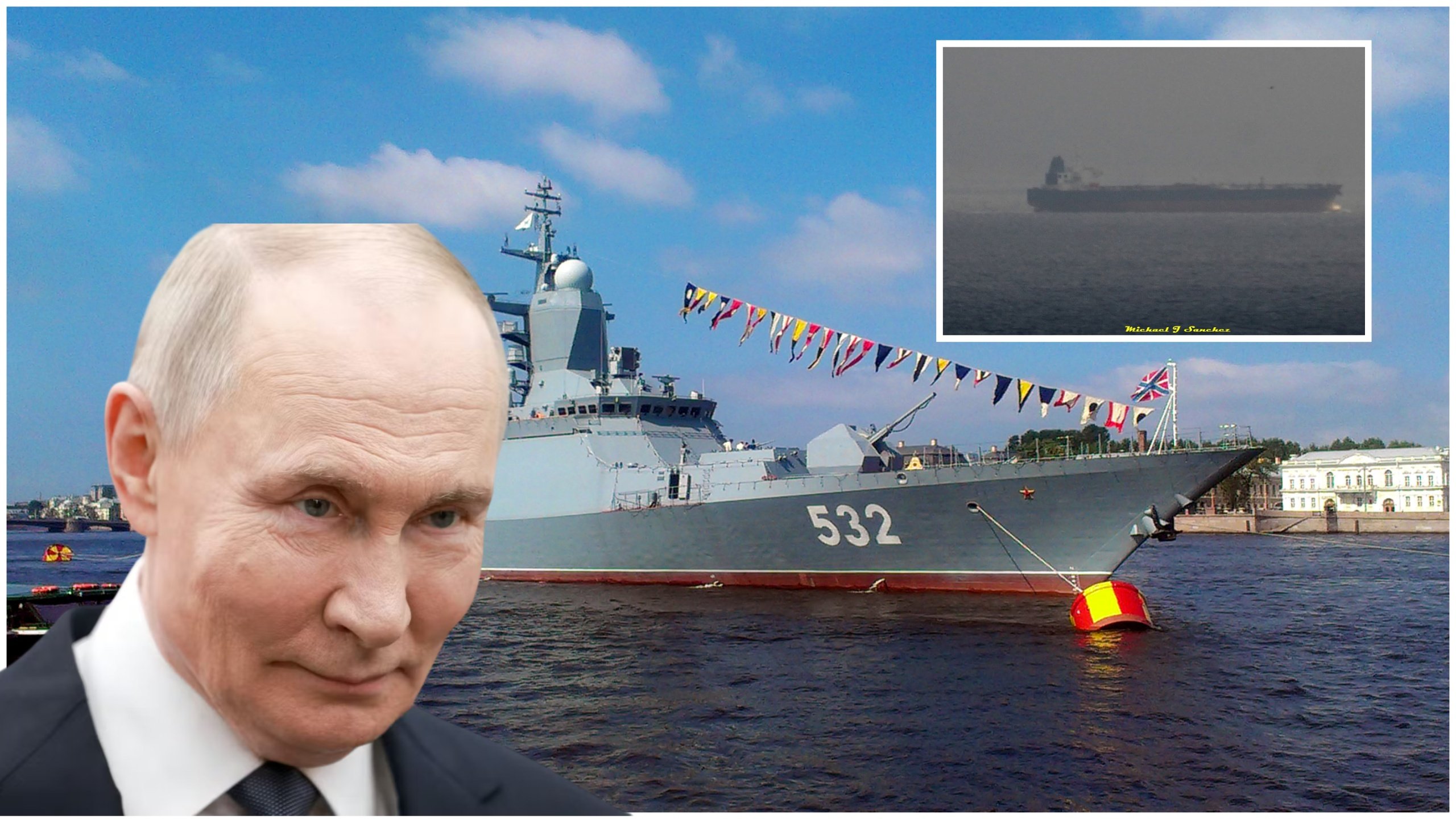
RUSSIAN activity has been ratcheting up in the Strait of Gibraltar as the Kremlin comes under increasing pressure to keep the oil flowing.
Data shared with the Olive Press reveals a 50% spike in Russian vessels traversing the strategic choke point in 2025 compared to the previous year.
Local Gibraltarian ship spotter Michael Sanchez recorded 299 Russian merchant and military ships passing the Rock last year, an increase of 99 vessels from 2024.
The figures reveal a significant ramping up of military muscle, with 43 warships passing through Spanish waters during 2025 – numbers not seen since 2021, before Putin’s full-scale invasion of Ukraine.
READ MORE: Surge in Russian ships through the Strait of Gibraltar sparks underpolicing fears
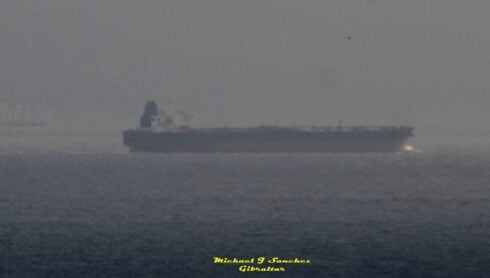
Photo: Michael J Sanchez
The alarming rise in naval traffic has brought Russian firepower dangerously close to the Spanish coast.
In December, the Russian corvette Boikiy was spotted lurking just 24 kilometres east of Gibraltar, visible from the Costa del Sol.
The warship, which spent two days patrolling the area, tried to pass itself off as other vessels on its digital tracker while it waited to escort two small Russian vessels through the Strait.
“They switched on their AIS (tracking system), believe it or not, masquerading as another ship,” Sanchez told the Olive Press from his observation post in the Upper Town of Gibraltar.
“It changed from trawler to tanker… and then a specific number came out and I realised, ‘hang on, it’s you’.”
This deception is part of a desperate new trend that the Russians have embarked on as the high seas become ever more hostile to their commercial traffic.
Sanchez warns the official figure of 299 ships is just the minimum because it does not include the ‘ghost fleet’ of tankers transporting oil in breach of international sanctions.

“The Russians are under a hell of a lot of pressure,” Sanchez explained.
“The only way they can carry on delivering their cargoes to Singapore, India, and China is by re-flagging them to the Russian registry so they can have military protection.
Sanchez described his confusion when he spotted Russian tankers leaving the Mediterranean that he had never recorded entering. “I never saw them going in – just coming out.”
“I said, ‘Where the hell are these tankers coming from?'”
After hours of cross-referencing databases, he cracked the code: the vessels were entering the Mediterranean under one identity and leaving under another.
“I realised, after a while… that at least four of these tankers were not Russian,” he said.
“I couldn’t find them in the database… then I somehow, by a quirk of fate, came across one with a different name, and it had a Gambian flag. And then I realised.”
The ships had switched flags and names mid-voyage to wash their identity clean.
This tactic was laid bare on the global stage when US forces seized the Russian-flagged tanker Marinera in the North Atlantic this week.
READ MORE: Kremlin off the hook as probe into Costa Blanca hit on Russian helicopter defector is shelved
The vessel, formerly named Bella 1, had switched its flag from Panama to Russia mid-pursuit in a bid to claim military protection.
The gambit ultimately failed. Despite Moscow warning Washington to back off and reportedly dispatching a submarine to the area, American forces boarded the vessel near Iceland on Wednesday.
The incident has underlined how the Kremlin has resorted to using its navy to escort the tankers and cargo ships as the threat of maritime sanctions close in.
Among the Russian warships to traverse the Strait of Gibraltar this year have been the frigate Almirante Golovko, the spy ship Viktor Leonov, and the submarine Novorossiysk.
READ MORE: EU countries shell out more for Russian gas than Ukraine aid, shocking report reveals
Sanchez believes Russian vessels are actively restocking Russia’s base in Tartus, Syria, contradicting reports that Moscow is retreating from the Mediterranean.
He noted that heavily laden ships like the Sparta IV and Yaz are likely carrying military equipment to the Syrian port.
“They are building up their posture in Tartus in Syria again,” he said. “The proof is that there are at least five Russian merchant ships off or in Tartus already.”
The data also highlights the failure of sanctions to stop Russian oil reaching friendly nations nearby.
Sanchez tracked the sanctioned tanker Stanislav Gogoruki drifting off Casablanca before delivering refined petroleum products to Tangier Med in Morocco, just across the water from Spain.
“Sanctions are not working,” Sanchez concluded.
“It should be reducing, we should be seeing less, but there was an increase of 99 ships… Russia is still moving its economy up and down the Strait.”
With seven Russian vessels crossing the Strait between December 30 and January 3 alone, the flow of traffic shows no sign of stopping as 2026 begins.
Click here to read more Spain News from The Olive Press.






What about the existing Olympic sized pool in La Cala? Will this become obsolete before most residents have even had the chance to use it? Many don’t even know it exists!!
Interesting, if slightly obtuse point …