

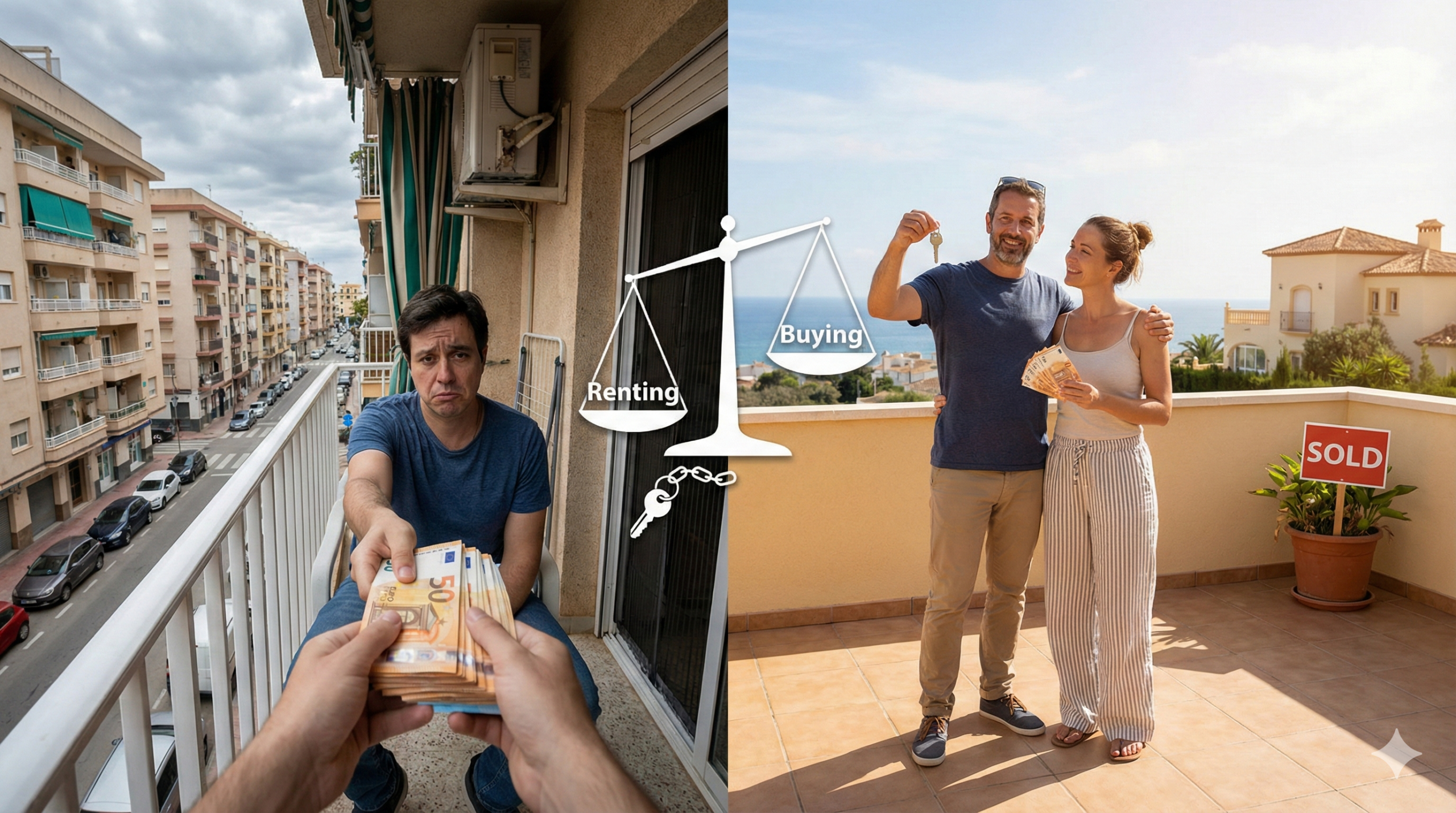
RENTING a home in Spain now requires a significantly larger chunk of a family’s income than buying one, according to new data.
The ‘financial effort’ required to rent a standard two-bedroom property has hit 38% of the average household income nationwide.
In stark contrast, those paying a mortgage are parting with just 26% of their monthly earnings.
This 12-point gap highlights a growing disparity in the Spanish property market, where tenants are being squeezed far harder than homeowners.
Experts generally recommend that housing costs should not exceed 30% of a household’s net income to ensure financial stability.
However, the latest study by idealista for the fourth quarter of 2025 shows that 12 provincial capitals have now smashed this safety limit for renters.
The situation is most critical in Malaga province, the heart of the Costa del Sol and a prime destination for British expats.
Here, the effort rate for renting has skyrocketed to 52%, meaning people are spending more than half their money just to keep a roof over their heads.
While buying in Malaga province is also expensive at 46%, it remains the more affordable option for those who can get on the property ladder.
The Balearic Islands are equally punishing, demanding 46% of income from both renters and buyers, making it the joint-most expensive place to own a home alongside Malaga.
On the Costa Blanca, the financial benefits of buying over renting are even more pronounced.
Tenants in Alicante province surrender 37% of their wages to landlords, whereas homeowners pay just 31% towards their mortgages.
Major cities show similar trends, with Valencia capital requiring 40% of income for rent compared to a much more manageable 27% for buying.
Barcelona remains a financial pressure cooker, demanding 46% of income for rent against 30% for a mortgage.
However, the lower monthly cost of mortgage repayments comes with a significant caveat.
The idealista study notes that the calculation does not include the savings required for a down payment, which is often the biggest hurdle for would-be buyers trapped in high-rent cycles.
The figures are based on the purchase or rental of a standard two-bedroom home using current market prices, while income data was cross-referenced with figures from the National Statistics Institute (INE).
Click here to read more Property News from The Olive Press.