
ANDALUCIA has just been to the polls.
Sunday’s election for control of the Junta de Andalucia (a bit like the Welsh or Scottish devolved assemblies for those more familiar with UK politics) has resulted in a victory for the Spanish conservatives.
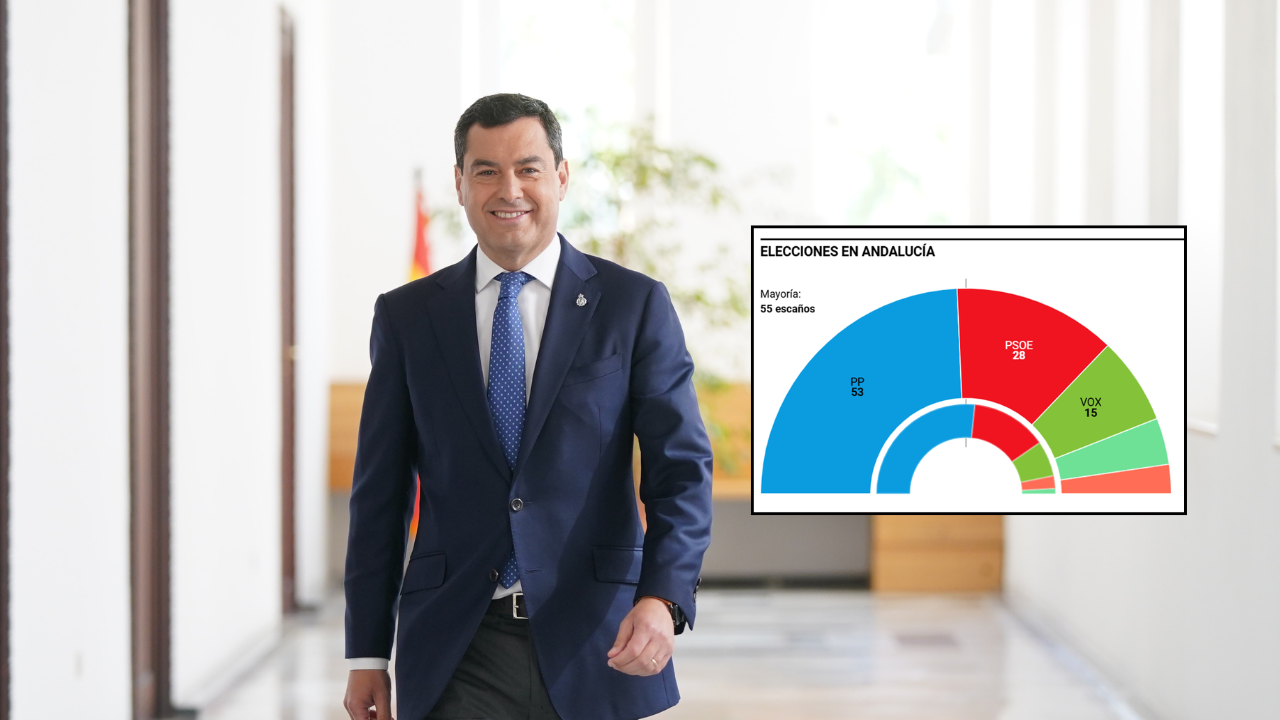
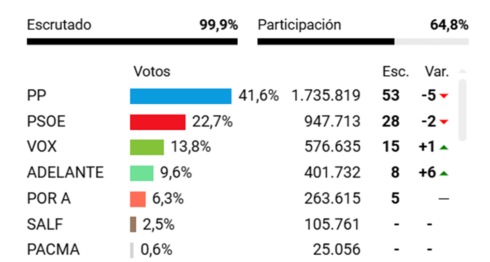
Of the 110 seats available, the Partido Popular (PP) won 53, two seats short of an all-out majority. The socialist PSOE now has 28 seats.
The PP was in control before the election, and so continues in power: PSOE will be disappointed with this performance, given that nationally Pedro Sanchez and the centre-left is the government of the day.
What has characterised this election is the surge achieved by the ‘anti-immigration’ parties, Vox and Adelante Andalucia.
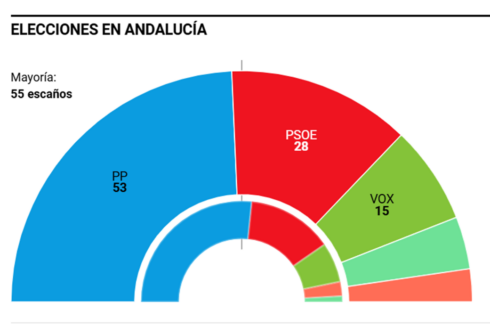
Together, they commanded 16% of the votes cast, and have gained seven extra seats, giving them a combined total of 23.
The question now is whether Juanma Moreno, leader of the PP and incumbent regional president, will feel able to govern alone, or will seek a coalition – known as a ‘pact’ in Spain.
He has previously ruled out a deal with far-right Vox, but he may be left with little choice if he hopes to maintain his grip on power.
What we might be witnessing is the death of the ‘old left’.
Antonio Maillo and his team at Por Andalucia are traditional communists, and they are clearly being outstripped by Adelante Andalucia, which broke away from them, and fits better in today’s social media world.
THE PARTIES
PP: The Partido Popular sees itself as the ‘natural governing party’ of Andalucia.
Though it lost five seats from 2022 at this election, it still has twice the voting-power of its deadly rival, the PSOE.
We can expect a ‘dead-ahead’ policy stance, but now the conservatives have to think about restricting immigration, if they are not to lose more ground to their left and right with Adelante Andalucia and Vox respecitvely.
PSOE: Maria Jesus Montero, regional leader of the moderate socialists, will no doubt blame the general malaise (centre-left politics seems to be in a trough, Europe-wide) and hysteria whipped-up against immigrants, but there is no disguising this poor performance.
The PSOE was underperforming in Andalucia before this election, but now it has lost a further two seats to reach an all-time low.
Vox: When it first grabbed the headlines a decade ago, VOX was a single-issue, ‘Muslims-out’ party.
However, with a lot of experience on local councils since then, it has developed a broad programme and has evolved into a serious voice in regional politics.
Is this the moment when VOX starts sharing government?
Adelante Andalucia: Translated as ‘Forward Andalucia’, this group is a new party, founded in 2018.
It emerged from a split in the far-left groupings, and describes itself as ‘For Andalucia, Feminist, Eco-Socialist and against the Neo-Liberals’.
Por Andalucia: This party emerged as an alliance of leftist parties and the Greens (the old United Left and Podemos have merged).
It’s even newer than Adelante Andalucia, having formed only four years ago.
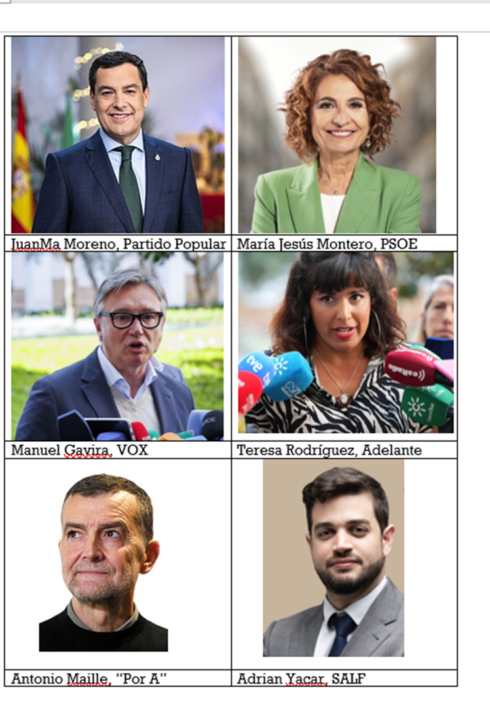
Their leader is hardened Communist candidate Antonio Maillo.
SALF: Se Acabo la Fiesta (‘The Party’s Over’) is a social media-focused grouping, centred on the personality of Alvise Perez.
It is far-right, nationalist, Eurosceptic and anti-immigration.
Adrian Yacar is its candidate for President of Andalucía.
PACMA: Pro-animal and anti-bullfighting, PACMA is a one-issue protest party.
LISTS AND PACTS
British first-past-the-post electioneering doesn’t work in Spain.
Here, the system’s different. The party leader submits a list of candidates, and the electorate votes for the party in general.
Suppose a party puts up a list of 100, and gets enough votes for 55 seats. Easy. The first 55 names on the list are ‘elected’.
This has two important effects.
First, the leader becomes super-important. Where he or she places you on the list can shape your whole career.
Second, there is no ‘winner-takes-all’ mentality, and the parties are always looking to ‘pact’, or share power.
Click here to read more Spain News from The Olive Press.