


SPAIN and Morocco have taken a fresh step toward a train line under the Strait of Gibraltar with engineers now drawing up the design for a 40km ‘test tunnel’.
The tunnel would run coast-to-coast between southern Spain and northern Morocco, forming the first physical stage of a highly ambitious plan to build a permanent rail connection under the second busiest shipping route in the world.
Crucially, the proposed terminal on the Spanish side would be placed near Barbate and Verjer so that it can connect into the Cadiz–Sevilla rail corridor, rather than terminating at Algeciras as in previous plans.
READ MORE: British telecoms giant Vodafone signs on for ambitious underwater tunnel between Spain and Morocco
On the Moroccan side, the terminal would link into the country’s expanding high-speed rail network around Tangier.
The details were outlined by senior Spanish and Moroccan engineers during a technical and institutional briefing at the Madrid College of Civil Engineers.
Representatives of Spain’s fixed-link study company SECEGSA and its Moroccan counterpart SNED said the project is in an ‘advanced planning stage’, with a joint three-year work plan currently underway.
Officials say the test tunnel would be used to study the rock and seabed conditions along the planned route, allowing engineers to confirm whether a full passenger and freight tunnel can be safely built.

It could also carry electricity cables and fibre-optic lines as a permanent infrastructure link between the continents, even if the full rail tunnel is delayed.
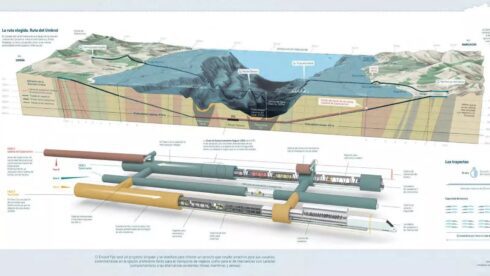
The tunnel would pass at depths of up to around 465m below the seabed, requiring a custom tunnel-boring machine designed to withstand extremely high pressure.
Spanish and Moroccan teams are currently carrying out seabed mapping, seismic monitoring and early-stage engineering modelling, with the design of the test tunnel expected to run into next year.
Engineers say the seabed under the Strait presents ‘zones of great tectonic complexity’, with deep hidden channels and layers of clay-like rock that may shift unpredictably under extreme pressures.
READ MORE: Challenge of the century: What exactly is involved in digging a tunnel from Spain to Morocco?
To deal with this, Spanish and Moroccan teams are now re-mapping the seabed and placing sensors on the ocean floor to monitor movement, while scientists from France and the United States are helping analyse the geological data.
If a full rail tunnel is approved, it would consist of two single-track tubes, each around 7 metres in internal diameter, running in parallel beneath the seabed. A smaller service and evacuation gallery would sit between them, linked by cross-passages every few hundred metres.
The underwater stretch would be roughly 28 kilometres long, at depths of almost half a kilometre below the seabed.
Trains would run through the tunnels rather than cars or lorries, with passenger and freight traffic handled together, similar to the Channel Tunnel model.
The project’s Spanish president, retired general José Luis Goberna explained that the tunnel project is a civil engineering scheme, not a military one, but said the Spanish Navy and their Moroccan counterparts are helping because they have the ships, sonar equipment and experience needed to survey the seabed.
He stressed this does not mean the project is under military control.
France was described as supportive but waiting to see the results of the current studies. French engineering institutes are taking part in the technical work, but France has not yet committed any funding.
Officials also said the European Union would need to play a major role in paying for the construction, if the project goes ahead.
The cost is not yet fixed, because it depends on what the exploratory tunnel discovers about the rock under the Strait.
However, based on current designs, the Spanish side alone is expected to cost around €8–9 billion, meaning the total project would likely exceed €10 billion once both countries’ infrastructure is included.
No date has been set for construction, and both governments will need to formally approve the works once the studies are complete.
The project has been revived under a joint three-year work plan agreed in 2023, which aims to update earlier feasibility studies originally prepared in the 2000s.
The fixed-link idea has existed since the 19th century, but modern planning began in 1979 when Spain and Morocco signed a cooperation agreement to explore a permanent crossing.
Further decisions on whether to proceed to drilling will be made after the current phase of studies concludes.
Click here to read more Andalucia News from The Olive Press.








An interesting project, hopefully not a white elephant as in the UK’s high speed rail project.
Current annual trade between Spain and Morocco is more or less the same as between Spain and Belgium, ut probably has the potential to grow, from being Spain’s 3rd largest customer outside the EU