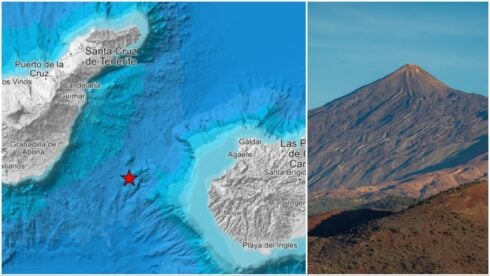


FEARS are mounting that Spain’s tallest volcano could be about to erupt after Mount Teide was rocked by more than 1,400 tremors in just a day.
But experts have called for calm, saying an eruption isn’t expected in the short term and that they are closely monitoring seismic activity.
The recent seismic swarm, recorded in the western area of Las Canadas del Teide between 6:00pm Monday and 8:00am Tuesday, is the eighth recorded event in the hotspot since 2016.
While the Instituto Geografico Nacional (IGN) initially counted 755 hybrid earthquakes, a detailed review revealed the true total exceeded 1,400, with many too weak to be felt by residents.
Experts describe the activity as a ‘new phase’ of volcanic behaviour on Tenerife.
According to Itahiza Dominguez, director of the IGN in the Canary Islands, the latest series of three swarms in just one week places the volcano ‘one step further’ in activity.
Scientists are not yet sure if this pattern will continue or fade out, but the probability of an eruption currently remains low in the short term.
Dominguez says it’s impossible to know if the activity will ultimately lead to an eruption.
The small tremors were mostly below 0.8 on the magnitude scale used to measure earthquakes caused by volcanic magma.
These events are not particularly unusual with previous episodes recorded in October 2016, June 2019, June and July 2022, November 2024, and February 12 of this year.
Statistically, Tenerife’s volcanoes can remain quiet for long periods, but the longer a system is dormant, the more likely it is that something could eventually happen.
Tenerife’s estimated eruption recurrence is roughly 100-200 years, with the last event occurring at Chinyero in 1909.
Each volcano behaves differently: some experience low-level signals for years without erupting, while others – such as La Palma or El Hierro – eventually build up enough magma underground to trigger an eruption.
Although nothing suggests an eruption is imminent, the recent uptick in tremors sets a reminder that Tenerife’s volcanoes are still active.
Historically, small earthquakes have preceded eruptions on the island, and scientists would only raise the volcanic alert from green to yellow after clear warning signs.
Specific signs could include significant ground deformation or the feeling of drastic tremors.
For now, experts urge the public to stay informed through official sources without panicking.
Tenerife is ‘extremely well-monitored,’ with over 100 stations operated by IGN and other institutions, to ensure that any change in volcanic activity is detected early.
Rosa Davila, president of the Tenerife Cabildo, has reassured the public that the island is ‘more prepared than ever’ for any volcanic scenario, highlighting continuous monitoring and coordination with local authorities.
Mount Teide is Spain’s tallest peak at 3,718 metres. It was formed 170,000 years ago and sits at the centre of Tenerife with an 80 metre crater that releases hot gases.
The site remains a hub for both scientific monitoring and tourism, sitting in the UNESCO World Heritage Teide National Park.
Despite Mount Teide being unusually active over the past week, the alarms remain at a low level.
Scientists will continue to monitor the situation closely, ready to respond should the tremors evolve into something more serious.
Click here to read more Spain News from The Olive Press.