

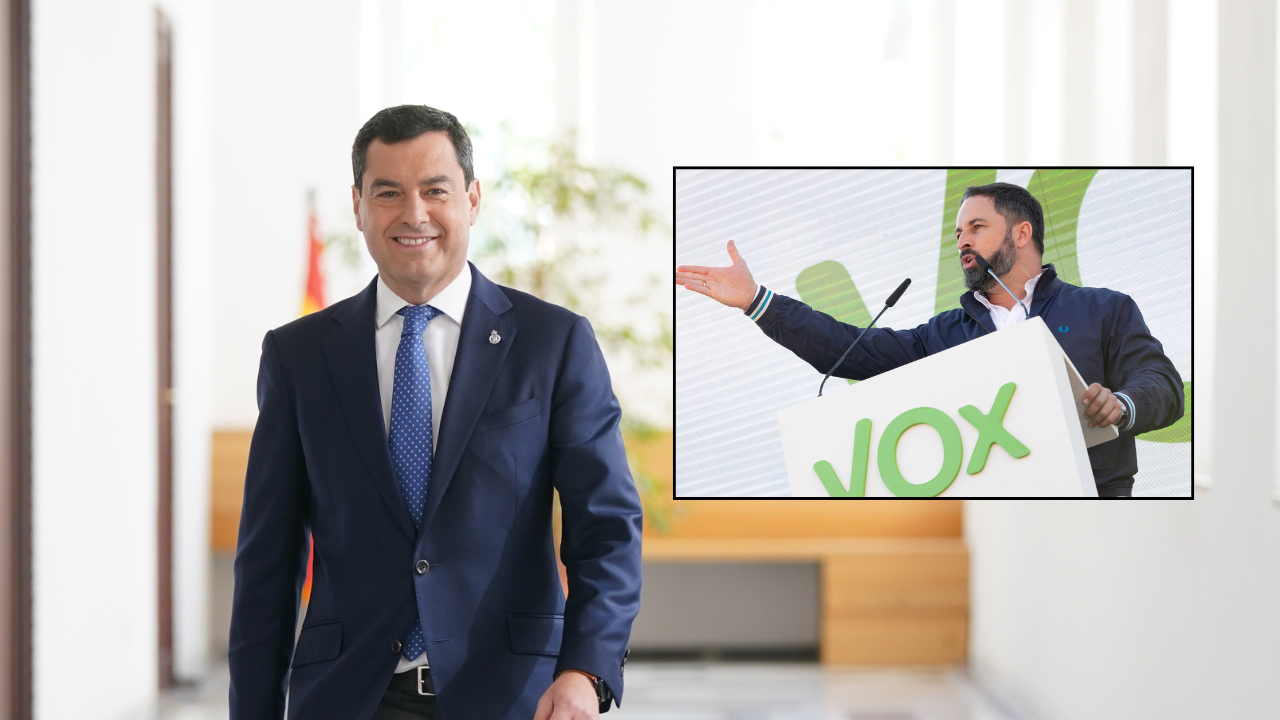
PRIOR to Sunday’s key regional election, Juanma Moreno was eager to rule out any form of coalition with the far-right.
“I have no interest whatsoever in governing with Vox,” the incumbent regional president told the press as recently as Thursday.
Curiously, it is far from taboo for regional leaders from the conservative Partido Popular (PP) to lean on their right-wing neighbours for support when necessary.
In recent years, the two parties have engaged in various confidence-and-supply arrangements in regions including Valencia, Castilla y Leon, Aragon and even neighbouring Murcia.
But Moreno, from the centre of his party, has never appeared quite as keen.
In truth, the 56-year-old – president of Spain’s southernmost mainland region since 2019 – probably thought he could go it alone.
At the last regional vote held in 2022, the PP scored an emphatic landslide victory with more than 43 per cent of the total vote share.
Added to that, several polls in the run-up to the weekend’s ballot suggested that the party could hang on to the more than 55 seats required to command a majority in their regional chamber.
But things did not go quite as planned.
As the votes trickled in on Sunday evening, it became clear that Moreno and his colleagues were set to fall short.
“We didn’t graduate with first-class honours, but we did get an outstanding grade,” he told supporters at a press conference in the capital Sevilla, unsure whether to celebrate a win or lament a lost majority.
In the end, the PP secured 53 seats in the regional parliament.
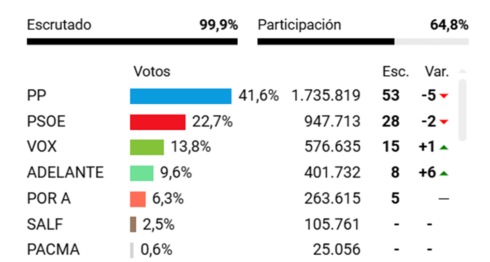
That represents a loss of five seats since the last election held four years ago, falling short of the 55 representatives necessary to rule without the help of other parties.
The PP, hopeful of another landslide victory to boost their momentum ahead of the next general election, won 41.6 per cent of the vote – an impressive amount, but a decrease of 1.5 percentage points from the previous vote.
That opens up the possibility that Moreno could have little choice but to U-turn on his pre-election pledge and, much to his dismay, strike a deal with Vox.
Santiago Abascal’s party, led at a regional level by Manuel Gavira, won 15 seats which, combined with the PP’s total, would be more than enough to pass legislation through parliament.
In theory, Moreno could turn elsewhere.
The PSOE, Adelante Andalucia and Por Andalucia secured 28, eight and five seats respectively.
But all three parties are from the left (the latter two from the far-left), which makes the prospect of an agreement essentially impossible.
Moreno has even mooted the possibility of still governing alone – although this seems unlikely.
According to reports, Moreno is yet to reach out to Vox.
If, or when, he does, he can expect a steadfast response from a party who feel like they are on the rise to power.
“We are going to exercise our responsibility and, above all, convey to all Spaniards the hope that a different way of doing politics is possible, that it is possible to change those things that some said could not be changed, and that we are going to exercise that responsibility from within the regional governments so that there is a bastion of defence against ruin, the mafia and the corruption of the PSOE,” Vox’s secretary-general Ignacio Garriga told a press conference on Monday.
At the heart of any deal will lie the so-called ‘national priority’ plan, one of the central planks of Vox’s immigration and welfare policy.
The proposal would give Spanish nationals, or those with what the party describes as ‘Spanish roots’, preferential access to certain public services ahead of foreigners.
That includes social housing, healthcare facilities and education.
Critics say the controversial policy risks discriminating against legal foreign residents living in Spain, including the large British and Irish expat community.
Given Andalucia is home to huge numbers of foreign residents along areas such as the Costa del Sol, any agreement handing Vox influence over regional policy could have significant repercussions for Brits living in southern Spain.
Click here to read more Spain News from The Olive Press.