
IT’S over the top, characteristically camp and arguably the world’s biggest singing competition.
Over the weekend, viewers from around the globe – but not Spain – tuned in to watch the 70th edition of the Eurovision Song Contest.
Despite the milestone, the anniversary felt less like a celebration of all things wonderful about music, with much of the world instead holding its breath or looking away.
In the end, Bulgaria made history in Vienna with the country’s first-ever win.
The upbeat dance tune ‘Bangaranga’, performed by 27-year-old Dara, took home the spoils after topping the table with a staggering 516 points.
It was the first time since 2017 that both the jury and popular votes aligned on the same song.
But the permanent Eurovision motto, ‘United By Music’, felt ironic at times, especially given recent geopolitical tensions which have clouded this year’s contest.
READ MORE: EXCLUSIVE: Costa del Sol talent that nearly made it to Eurovision

Landing right behind Bulgaria was Israel, narrowly missing out for the second year in a row on what would have inevitably been a deeply divisive victory.
Spain, a usual fan-favourite, joined Ireland, Iceland, the Netherlands and Slovenia in boycotting the event, citing the ongoing participation of Israel in the context of the war in Gaza.
Eurovision prohibits the use of its platform for ‘political expression, activism, […] or the promotion of external causes or agendas,’ but recent editions of the popular contest have been shrouded in controversy.
It all started in 2022, following Russia’s invasion of Ukraine.
Russia was first added to Eurovision in 1994, when it hosted the event from Shabolovka Studios in Moscow.
However, the country was disqualified in 2022 over the war in Ukraine – and has not been asked to return.
That year, Ukraine won Eurovision with the song ‘Stefania’ by Kalush Orchestra, with the UK finishing a rare second (they received nul points from viewers for the third consecutive contest this year).
A year later, conflict once again reared its ugly head amid war between Israel and Palestine.
Despite its participation in a deeply divisive war, Israel has not been disqualified from competing at Eurovision – a move that has prompted several countries to boycott the annual event entirely.
That includes Spain, one of the ‘Big Five’ countries who are granted an automatic spot in the final thanks to their financial contribution to the competition.
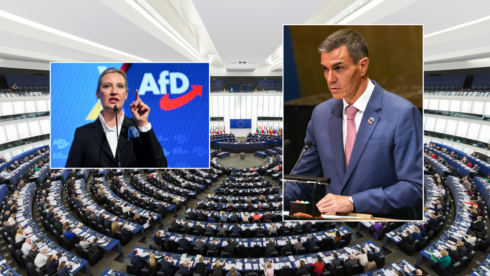
Spanish officials – including prime minister Pedro Sanchez – have criticised the European Broadcasting Union, the organisers of Eurovision, of perpetuating a ‘double standard’ by removing Russia but allowing Israel to remain.
Keeping true to a promise made in 2025 that they would sit out the following year if Israel was still allowed to compete, Spain did not participate in this year’s Eurovision.
It was the first time a Spanish representative was not present since they debuted in 1961.
Prior to the show’s live airing on Saturday, Sanchez held firm on his stance against boycotting the singing competition.
READ MORE: BREAKING: Spain boycotts next year’s Eurovision Song Contest after Israel allowed to compete
Sanchez credited Spanish public broadcaster RTVE for making a decision that he said was both ‘consistent and necessary to stand up against injustice.’
The Spanish premier argued that while the country would not be present in Vienna, Spaniards believe they will be ‘with the conviction of being on the right side of history.’
RTVE also posted a message of solidarity for Palestine ahead of Saturday night’s Eurovision finale, claiming ‘human rights are not’ a competition.
The X post, shared by @ESCdiscord, shows RTVE’s end to their statement: ‘Peace and Justice for Palestine.’
Spain isn’t the only country to make a major statement.
READ MORE: UK Eurovision entry sparks controversy in Spain for appearing to endorse ‘balconing’
With the loss of several major contenders, including Ireland – the country with the most Eurovision wins – it has been said that Eurovision has begun to lose both viewership and credibility.
Even Belgium, the so-called ‘heart of the EU’, has now threatened to withdraw from next year’s contest if Israel remains.
Plenty of Eurovision fans are grappling with mixed emotions over the continued issues.
Separately, a recent New York Times investigation analysed Israel’s alleged efforts at using Eurovision as a power tool.
Israel is said to have spent at least €1 million in marketing for their representatives in the contest, with some of the money potentially coming from prime minister Benjamin Netanyahu’s office.
The accusation comes despite governments being prohibited from intervening in the Eurovision competition.
The NYT has also claimed undisclosed voting data, Eurovision documents, and interviews with more than 50 people found that Israel’s campaign could have changed the outcome of last year’s contest.
In several countries where Israel is deemed unpopular through polls, their 2025 representative won the popular vote – a move that raised some eyebrows in suspicion, including in Spain
Isaac Herzog, Israel’s ceremonial president, claimed that the country’s voice ‘should be heard everywhere.’
‘We should participate, we should raise our flag high, and we should bring the best performers to Eurovision,’ Herzog said.
About 15 minutes before Eurovision aired at 9pm Central European Time (CET), Al Jazeera posted breaking news that an Israeli attack on Gaza killed at least 11 Palestinians.
While Israel’s 2026 song ‘Michelle’ by Noam Bettan placed second, it wasn’t without its own issues.
Israel made a jump up to the lead with 343 points at one point in the night, received by a collection of booing that could be heard in the background of the crowd, and was noted by BBC commentator Graham Norton
It felt as if the world was holding its breath during the final tallying of votes, with Bulgaria making an unexpected sweep of a win to surpass Israel by 173 points.
Spain expressed their anger at Eurovision by refusing to broadcast the competiton – so what were Spaniards watching instead?
Spain’s RTVE aired a tribute to the country’s musical history, including performances by this year’s Benidorm Fest winners Tony Grox and LUCYCALYS with the song ‘T amare’.
The national music competition Benidorm Fest, which typically serves as the official selection process for Spain’s Eurovision entry, continued this year as an independent music event rather than the qualifier.
The future of Eurovision and Spain’s participation is unknown.
But for some, the competition has already lost its authenticity.
Additional reporting: Ben Pawlowski
Click here to read more Spain News from The Olive Press.